|
Extracted from: Brooks R.W., (1983). Systematics and Bionomics of Anthophora: The Bomboides Group and Species Groups of the New World (Hymenoptera: Apoidea, Anthophoridae). University of California Press vol. 98, ISBN: 0-520-09568-4
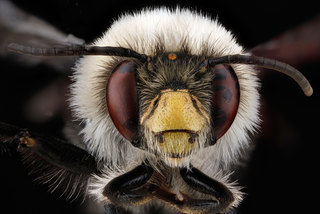
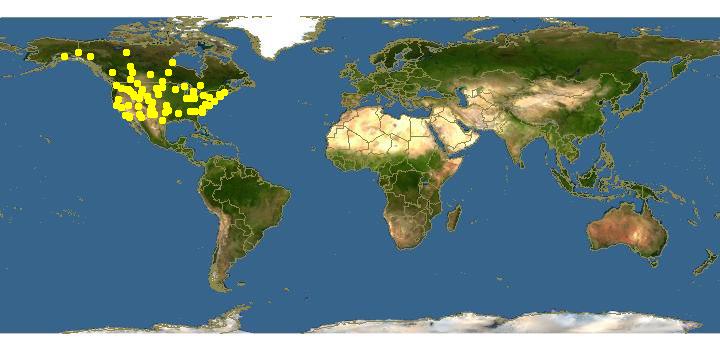
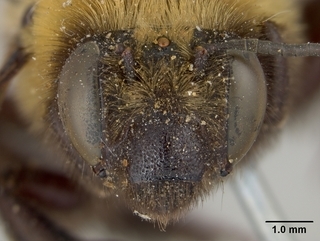
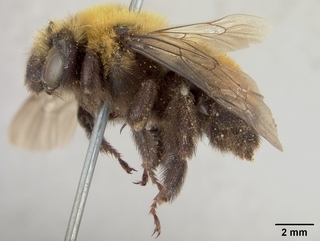
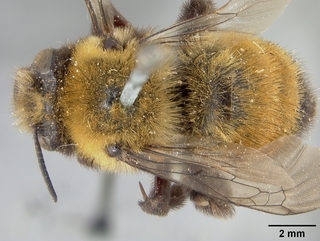
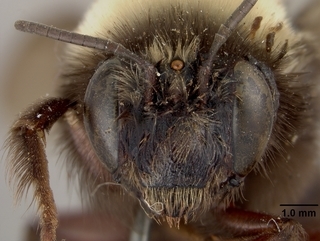
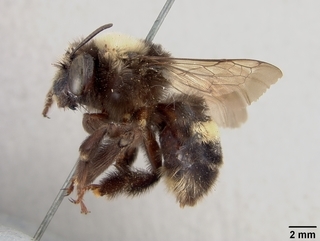
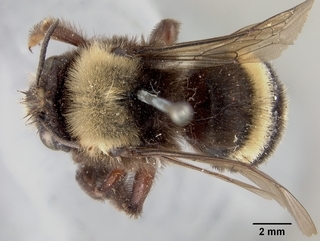
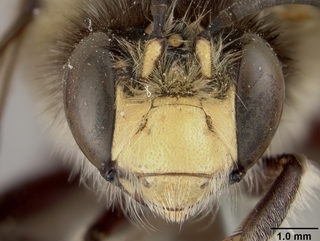
Anthophora bomboides (Map 1) is closely related to A. occidentalis and abrupta and can be separated easily by vestiture color patterns. A. occidentalis is covered completely with ochraceous pubescence (except for a few black hairs on the venter), while abrupta always has an ochraceous thorax and all-black abdomen. A. bomboides is variable in color, but never has the above color combinations. Structural characters are given in the key. The description below is based on the nominate form. Vestiture color and measurements are omitted, but given in detail for -each subspecies.
FEMALE
Integumental Color: Black, mandible with apical half rufescent; ocelli amber; femur and tibia with inner surfaces and tarsus dark rufescent, except tips of tarsal claws; tibial spurs amber.
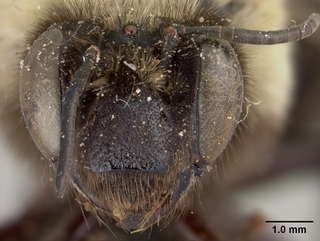
Structure: Scape about equal to combined lengths of pedicel and flagellomere 1; flagellomere 1 equal to length of flagellomeres 2-4; flagellomeres 2-3 about as long as wide; flagellomeres 4-10 about 1.33 times as long as wide. Eye viewed from front slightly more than 2.5 times as long as wide; eyes diverging slightly above. Mandible with a tooth 0.10 of its length from apex, in repose surpassing midlabrum by over 0.20 mandibular length. Malar space 0.14 width of mandibular base. Galea with apex blunt; outer surface with scattered, fine punctures with fine tesselation between. Stipes with lower margin lined with long hair 0.75 length of stipes. Lacinia with lower margin lined with hair as long as lacinia. Maxillary palpus with six segments; ratios of lengths from base to apex, 1:2.4: .8:1.7: .6: .3. Labial palpus with four segments; ratios of lengths from base to apex, 1: .19: .04: .04. Labrum strongly convex and rugose; rugae shiny with insides of punctures tessellate; apical margin thickened; width slightly less than width of clypeus. Clypeus with interspaces between irregular punctures shiny but weakly tessellate; punctures separated by 0.5-1 puncture width; punctures smaller near margins; supraclypeal area with punctation as on upper clypeus. Inner antennal area with fine, confluent, irregular punctures. Ocellar triangle with similar punctures, except for impunctate space connecting lateral ocelli. Vertex with submedian, highly polished, impunctate area. Paraocular area with fine, irregular, nearly confluent punctation. Gena with punctures fine and regular.
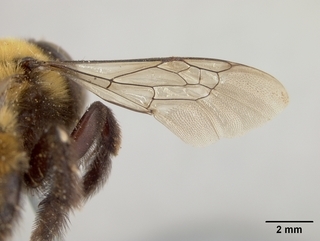
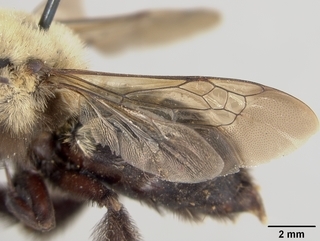
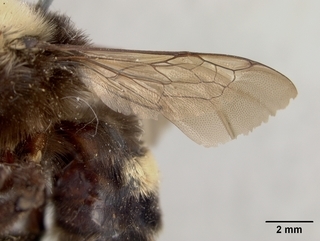
Pronotum equal in width to vertex; punctures fine and irregular. Scutum shiny with large punctures peripherally confluent to separated by 0.5 puncture width; punctures scattered near middle, with interspaces tessellate to polished. Scutellum with large punctures separated by 0.5 puncture width. Metanotum 0.25 as wide as scutellum, with punctures separated by 1-2 puncture widths. Propodeum shiny; propodeal enclosure laterally with large punctures separated by about one puncture width; interspaces of punctures and median area with fine linear punctures; lateral surfaces with large regular punctures. Mesepisternum with large nearly confluent punctures. Anterior margin of submarginal cell 2 six�tenths as long as that of submarginal cell 3. Mid and hind tibial spurs with distal fourths gently curved. Hind basitarsus with posterior distal process sharply acute. Tarsal claws cleft 0.33 of length from apex.
Metasomal terga 1-3 with large punctures nearly confluent, becoming separated by 1-2 puncture widths near apical margins; posterior margins with narrow impunctate band. Metasomal tergum 4 with large, irregular punctures separated by 1-2 puncture widths, interspaces tessellate; posterior margin with impunctate area widest at middle. Metasomal tergum 5 with punctation similar to 4. Pygidial plate V-shaped, basal width twice length. Sterna with large punctures in postgradulus, separated by 2 puncture widths; pregradulus with very fine linear punctures.
MALE
Integumental Color: Black, except mandible with small basal yellow mark; labrum yellow, except for basal lateral mark; clypeus yellow, except apical lateral corners and around tentorial pits; paraocular area with narrow yellow band as wide as flagellum, paralleling epistomal suture to base of clypeus; supraclypeal mark yellow, rectangular, and half as wide as flagellomere 1, but not touching paraocular marks; scape with yellow anteriorly. Legs and metasomal sterna rufescent.
Structure: Like female, except scape equal to combined lengths of pedicel and flagellomeres 1-2; pedicel 0.67 as long as flagellomere 2; flagellomere 1 about equal in length to next 1.5 flagellomeres flagellomere 2 three�fourths as long as flagellomere 3; flagellomeres 3-10 two-thirds as wide as long. Mandible in repose surpassing midlabrum 0.17 of mandibular length; dorsal tooth 0.25 of mandibular length from apex. Like female, except maxillary palpus with ratios of lengths from base to apex, 1:3.1:1.8:1.3: .7: .3. Labial palpus with ratios of lengths from base to apex, l:.27:.03:.03. Labrum with large irregular punctures. Clypeus with large regularly spaced punctures separated by about 1 puncture width.
Metanotum 0.33 as long as scutellum. Hind basitarsus dilated with anterior tooth; posterior, distal margin angulate.
Metasomal tergum 7 with posterior margin carinate, broadly but deeply emarginate, resulting two angles acute. Metasomal sternum 6 with posterior margin medially produced and weakly emarginate (j9. 10); metasomal sterna 7-8 as in Figures 16 and 25, respectively. Genital capsule as in Figure 33.
Vestiture: See subspecific description.
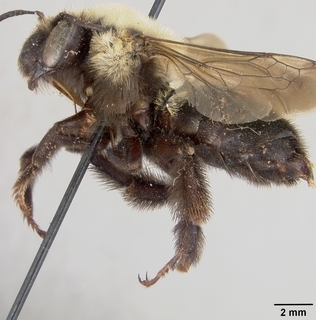
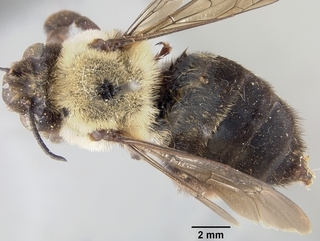
Anthophora bomboides is divided into five subspecies. This large, common species was treated to a limited extent by Cockerell (1936). The nominate form has the vestiture of the scutum pale, metanotum black, metasomal terga 1-2 and sometimes 3 pale, and the remaining terga black. This form occurs on the east coast of the United States and through Canada, where it intergrades with sodalis in Alberta and Saskatchewan.
A. b. sodalis has the thoracic dorsum and metasomal terga 1-3 and sometimes 4 covered, with red, but occasionally pale hair. This form occurs from the Midwest to California and Oregon and into Canada, where it intergrades with solitaria. A. b. solitaria has the scutum red, metanotum black (mostly pale in males), and metasomal terga 1-3 and sometimes 4 red. This subspecies occurs in Washington and British Columbia.
A. b. stanfordiana occurs in California and Oregon (one male has been collected at Seattle. The scutum is pale, metanotum dark (pale in male); metasomal tergum 2 yellow with terga 3-7 having yellow and black hair intermixed (male has terga 1-2 and sometimes 3 with yellow hair). The aterrima form is closest to stanfordiana. The female is all black, and the male has a few pale hairs on the face and thoracic dorsum. This rare subspecies has been found in only one county in California.
Reprinted with permission from: Mitchell, T.B. 1962 Bees of the Eastern United States. North Carolina Agricultural Experiment Station Technical Bulletin No. 152.
FEMALE�Length 14-14.5 mm., breadth of abdomen 5.5-6 mm.; black in general, legs somewhat more piceous, mid and hind spurs brownish-piceous, and hind tarsi becoming somewhat brownish; wings lightly and rather uniformly infuscated, veins piceous; mandibles with a distinct, inner, subapical tooth; cheeks subequal to eyes in width; clypeus strongly protuberant, its median length very slightly greater than half the distance between eyes below; eyes very slightly convergent below; basal segment of flagellum much longer than segments 2 and 3 combined, nearly equal to segments 2-4; labrum considerably broader than its median length; cheeks and upper part of face with very fine and densely crowded punctures, these becoming somewhat coarser below level of antennae, quite coarse and well separated on clypeus, and very coarse and irregular on labrum medially; punctures in median area of scutum posteriorly fine and very sparse, the scutum, scutellum and pleura otherwise finely and densely punctate throughout; propodeum somewhat more shining, impunctate along median area of posterior face, otherwise punctures rather coarse and distinct, somewhat separated; punctures on the more basal abdominal terga very close, rather fine but distinct, becoming somewhat more shallow and indistinct but more widely separated on the more apical terga, apical margins narrowly smooth and impunctate; pygidium elongate, slightly narrowed apically, apex narrowly rounded; pubescence of head copious and elongate, largely black, with pale hairs around antennae and ocelli and across vertex; scutum with some inconspicuous fuscous or black hairs in the median, sparsely punctate area, and venter of thorax with some black pubescence beneath, otherwise thorax with copious, dense, pale ochraceous pubescence; legs chiefly black pubescent, but front femora fringed posteriorly with long pale hairs; abdominal terga 1-3 entirely covered with copious, rather short, pale ochraceous pubescence, that on the remaining terga black.
MALE�Length 13.5-14.5 mm., breadth of abdomen 4.5-5.5 mm.; black, clypeus entirely yellow and face narrowly yellow along its lateral and upper margins; labrum broadly yellow, but with some black at lateral angles and along apical margin; mandibles with a small basal yellow maculation; antennal scape with a small anterior, subapical, yellow maculation; tegulae and legs largely black, tarsal segments somewhat tinged with brownish or piceous, spurs brownish-piceous; wings subhyaline to very faintly brownish, veins brownish to piceous; cheeks subequal to eyes in width; clypeus strongly protuberant, its median length somewhat greater than half the distance between eyes below; eyes very slightly convergent below; basal segment of flagellum slightly shorter than segments 2 and 3 combined; hind basitarsi dilated at base, with a strong, subacute, inferior angle; upper part of face very finely and densely punctate, punctures becoming more distinct and coarse below, those on clypeus becoming quite sparse but rather shallow and vague apically, irregular but quite coarse on labrum; median area of scutum posteriorly very minutely and sparsely punctate, the scutum, scutellum and pleura otherwise very finely and densely punctate, propodeum somewhat more deeply and distinctly so, the punctures slightly separated, rather coarse, but shallow and sparse on lateral faces, median area of posterior face narrowly impunctate; punctures of abdominal terga very fine, quite close but distinct on the more basal terga, becoming minute and more sparse on the more apical terga, apical margins rather broadly impunctate; face largely pale pubescent, hairs long and erect, cheeks pale pubescent beneath, becoming blackish or fuscous above, and with intermixed black hairs across vertex and below ocelli; scutum with a median, posterior patch of black pubescence, thorax otherwise entirely covered with dense, copious and erect, pale ochraceous pubescence; legs largely black pubescent, but front femora and tibiae fringed posteriorly with elongate, pale hairs; terga 1-3 largely or entirely covered with dense, erect, quite copious, pale ochraceous pubescence, that on the more posterior terga elongate, darker but thinner, becoming pale at extreme sides; apical margin of tergum 7 subcarinate, broadly but rather deeply emarginate, the two resulting angles subacute; sterna 7 and 8 as shown (fig. 92); genital armature similar to abrupta (fig. 91).
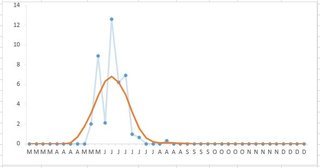
DISTRIBUTION � Michigan to Maine, south to Georgia, June to August.
FLOWER RECORDS � Ceanothus and Pentstemon.
The recognition of several subspecific forms of bomboides in the West necessitates the subspecific designation of this typical form.
Anthopora ravi
Reprinted with permission from: Mitchell, T.B. 1962 Bees of the Eastern United States. North Carolina Agricultural Experiment Station Technical Bulletin No. 152.
FEMALE�Length 12.5-14.5 mm., breadth of abdomen 5-5.5 mm.; black, the more apical flagellar segments reddish-piceous beneath, tegulae and legs largely black, the more apical tarsal segments somewhat more piceous, and spurs piceous; wings very lightly infuscated, veins piceous to black; cheeks subequal to eyes in width; clypeus strongly protuberant, its median length very slightly greater than half the distance between eyes below; eyes very slightly convergent below; mandibles with a low, inner, subapical angle or tooth; width of labrum considerably greater than its median length; basal segment of flagellum slightly exceeding segments 2 and 3 combined in length; face very finely and densely punctate, punctures of clypeus considerably coarser and deeper, becoming somewhat separated toward apical margin, those on labrum very coarse and irregular; cheeks with rather deep and distinct but quite fine and close punctures; median area of scutum posteriorly shining and impunctate over a limited area, the scutum, scutellum and pleura otherwise finely and very closely punctate; propodeum somewhat more deeply and distinctly punctate, posterior surface somewhat shining, punctures rather sparse, lateral faces dull, punctures quite close in general; the more basal abdominal terga quite finely and closely punctate, but punctures rather deep and distinct, becoming more sparse on the more apical terga; pygidium narrow and elongate, tip narrowly rounded; pubescence of head largely blackish or fuscous, with some intermixed pale hairs between antennae and on vertex, cheeks below with some very long pale hairs; scutum with a median black patch of erect hairs posteriorly, thorax otherwise quite densely covered with copious, pale ochraceous pubescence; abdominal terga 1 and 2 quite copiously pale ochraceous pubescent, more elongate on the basal segment, somewhat shorter on 2, short and fuscous on 3-5; pubescence of legs largely black, anterior femora with some pale hairs in the posterior fringe.
MALE�Length 13-15 mm., breadth of abdomen 4.5-5.5 mm.; black, clypeus entirely yellow; labrum largely yellow, but black laterally and very narrowly across apical margin; subpraclypeal area with an apical, yellow strip adjacent to margin of clypeus, and lateral areas of face adjacent to clypeus more or less completely yellow maculated; antennal scape and base of mandibles yellow maculated or not; legs black, spurs fuscous to blackish; tegulae brownish-piceous; wings subhyaline basally, becoming faintly clouded apically, veins piceous to black; mandibles slender and simple; cheeks subequal to eyes in width; clypeus strongly protuberant, its median length somewhat greater than half the distance between eyes below; eyes very slightly convergent below; basal segment of flagellum about equal to segments 2 and 3 combined; hind basitarsi strongly dilated at base, acutely angulate beneath; black areas of face above very finely and densely punctate, surface dull, maculated areas below much more distinctly punctate, the punctures becoming rather irregular and somewhat sparse on clypeus apically, those on labrum quite coarse but rather close and irregular; a limited median area of scutum posteriorly somewhat shining and sparsely punctate, otherwise scutum, scutellum and pleura very finely and densely punctate; propodeum somewhat more shining, deeply and distinctly punctate, rather sparsely so on posterior face, rather closely so on lateral faces; punctures of abdominal terga fine, close and quite distinct, becoming rather sparse and irregular on the more apical terga; head with quite copious and elongate, pale pubescence, more yellowish above, whitish below, sometimes fuscous or blackish on upper part of cheeks, and with intermixed dark hairs around ocelli and across vertex; scutum posteriorly usually with some intermixture of black hairs in the generally light pubescence, thorax otherwise quite copiously covered with elongate, pale ochraceous pubescence; legs black pubescent in general, but front pair fringed posteriorly with pale hairs, and mid and hind coxae and trochanters with considerable pale pubescence; abdominal terga 1 and 2 densely covered with pale ochraceous pubescence, that on 3-7 entirely fuscous or blackish; tergum 7 subcarinate apically, with a broad but deep, somewhat rounded emargination, the two resulting lateral projections narrowly rounded; sterna 7 and 8 resembling those in bomboides (fig. 92); genital armature as in abrupta (fig. 91).
DISTRIBUTION � Colorado to New York, May to July.
|
|
Extracted from: Brooks R.W., (1983). Systematics and Bionomics of Anthophora: The Bomboides Group and Species Groupd of the New World (Hymenoptera: Apoidea, Anthophoridae). University of California Press vol. 98, ISBN: 0-520-09568-4
Anthophora bomboides bomboides
Typically has the scutellum and metanotum with a dark patch of hair. The only other subspecies that has this vestiture pattern is solitaria. However, solitaria is largely red in the female, and the male lacks the black patch of hair on the thorax.
FEMALE
Measurement and Ratios: N=10; length, 12-15 mm; head
width/length, 1.45-1.64; thoracic width, 2.8-4.6 mm; abdominal width, 5.1-5.7 mm.
vestiture: Generally black. Head hair black, except pale on supraclypeal area; ocellar triangle and vertex predominantly white, with some black intermixed. Thorax with white hair, except for patch of black on posterior half of scutum. Legs with black hair, except white on fore femur. Metasomal terga 1-3 with long white hair; terga 3-5 with white hairs laterally.
MALE
Measurements and Ratios: N=10; length, 11-13 mm; head width/length~.43-1.67; thorax width, 3.1-4.0 mm; abdomen width, 4.6-5.3 mm.
vestiture: Like female, except pale hair on hypostomal area, fore legs, and outer apices of mid and hind tibiae and basitarsi. Midtibia with orange hair anteroapically. Metasomal sterna 4-5 on posterior margins with fringe of dense, black hair as long as postgradulus.
Anthophora bomboides aterrima Cockerell, New Status
A. b. aterrima is superficially like the dark form of A. pacifica Cresson. This melanic subspecies is closest to h. stanfordiana, but differs in that the female is all black and the male has the metasoma all black, though occasionally with a few pale hairs on tergum 1.
FEMALE
Measurements and Ratios: N=2; length, 14 mm; head
width/length, 1.54-1.64; thoracic width, 4.0 mm; abdominal width, 5.3-5.4 mm
Vestiture: All black.
MALE
----Measurements and Ratios: N=2; length, 14 mm; head width/length, 1.54-1.64; thoracic width, 4.0 mm; abdominal width, 5.3-5.4 mm
Integumental Color: As in typical bomboides, except clypeus all yellow. Paraocular area with yellow extending above clypeus. Legs black, except tarsi rufescent.
vestiture: Black, except hypostomal area, face ocellar triangle with pale hair; scutum with anterior half and mesepisternum with upper area anteriorly with pale hair, thorax ventrally with brown hair.
|