| ||||||
Ceratocystis fimbriata Ellis and HalstedMango blight; Mango wilt; Cacoa wilt; Rubber mouldy rot; Sweet potato black rot; Coffee canker; Aspen black canker; Aspen target canker; Taro black rot; Plane tree canker stain; Mallet canker |
|---|
| Links |
We parsed the following live from the Web into this page. Such content is managed by its original site and not cached on Discover Life. Please send feedback and corrections directly to the source. See original regarding copyrights and terms of use. |
| Names | |
| |
| Following served from Iowa State University |

| Following modified from Iowa State University |
The following information was compiled for the CABI Crop Protection Compendium, CABI Publishing. Updated 2001 by C.J. Baker and T. C. Harrington and by T. Harrington in 2004. This information was gathered in part through funding by the National Science Foundation (DEB-9870675 and DEB-0128104).
PREFERRED SCIENTIFIC NAME: Ceratocystis fimbriata Ellis and Halsted CLASS: Pyrenomycetes ORDER: Microascales
FAMILY: Ceratocystiaceae
Common names of diseases
English :
Ceratocystis blight , blight of mango , wilt disease of cocoa , cacao wilt , mouldy rot of rubber , black rot of sweet potato , canker of coffee , Ceratostomella wilt, mango blight , black cane rot of Syngonium , black canker of aspen , black rot of sunn hemp , black rot of taro , canker stain of plane tree , Ceratocystis canker , Ceratocystis wilt , mallet canker , mango wilt , sweet potato black rot , target canker of aspen ,
Notes on taxonomy and nomenclature A fungus attacking Coffea in Indonesia was described as Rostrella coffea (Zimmerman, 1900), and this species was later synonymized with C. fimbriata (Pontis, 1951), although no careful comparisons have been made. Walter et al. (1952) designated the pathogen attacking Platanus as a separate form, C. fimbriata f. platani , based on its purported host specificity. Another form, occurring on Acacia mearnsii and species of Protea in South Africa, is now considered a separate species, C. albofundus (Wingfield et al., 1996); it is likely native to southern Africa (Roux et al., 2000). C. variospora , found on Quercus and described by Davidson (1944), is similar to C. fimbriata (Hunt, 1956). Although Upadhyay (1981) considered C. variospora a synonym of C. fimbriata , it is probably a separate species. It is becoming increasingly apparent that C. fimbriata is a complex of many species, each with a unique host range and geographic distribution.
Notes on host range Cross-inoculation studies have established the host-specificity of some of these types. For example, isolates from Mangifera (Ribeiro and Coral, 1968), Ipomoea , Platanus , Gmelina , Coffea , Xanthosoma , Eucalyptus (Baker et al., 2003), Crotalaria , Cajanus and Acacia (Coral et al., 1984) did not infect Theobroma . Isolates from Ipomoea and Colocasia were host-specific when inoculated to these two hosts (Mizukami, 1951), as were isolates from Hevea and Ipomoea (Olson and Martin, 1949), and Coffea and Ipomoea (Pontis, 1951). Isolates from Coffea , Prunus , Theobroma , Quercus and Colocasia failed to infect Ipomoea (Kojima and Uritani, 1976). Isolates from Platanus , Prunus (almond and apricot), Mangifera , Xanthosoma , Gmelina , Eucalyptus and Theobroma were not pathogenic to Ipomoea, and isolates from Ipomoea , Prunus (almond and apricot), Platanus , Coffea , Mangifera , Xanthosoma , Gmelina , Eucalyptus and Theobroma were not pathogenic to Platanus (Crone, 1963; Baker et al., 2003). Costa Rican isolates from Theobroma , Coffea and Xanthosoma were specialized to their respective hosts (Baker et al., 2003). Among Brazilian isolates from various hosts, only a Gmelina isolate could infect Gmelina (Baker et al., 2003). A Syngonium isolate from Australia infected various cultivars of Syngonium , other Araceae and Crotolaria , but not Platanus , Prunus spp., or Ipomoea (Vogelzang and Scott, 1990). Each host-specific type of C. fimbriata appears to have a distinct geographic distribution, although the total number of types and the geographic and host boundaries of each of them have not been fully determined. Several recorded host plants for C. fimbriata are not included in the listing because they have not been confirmed. Some of these are probably erroneous reports, including the reports of C. fimbriata on soyabean ( Glycine max ), tobacco ( Nicotiana species), potato ( Solanum tuberosum ), chestnut ( Castanea sativa ), cucumber ( Cucumis sativa ), kidney bean ( Phaseolus vulgaris ), coconut ( Cocos nucifera ), pineapple ( Ananas comosus ) and yam ( Dioscorea species). There is also considerable confusion over the scientific and common names of edible members of the Araceae ( Xanthosoma , Colocasia and Alocasia for example), and it is not always clear which of these genera are referred to in the various reports. Laboratory experiments have demonstrated C. fimbriata infection of Caladium , Dieffenbachia (Vogelzang and Scott, 1990) and several wild Ipomoea species (Clark and Watson, 1983) that have not been recorded as hosts in nature.
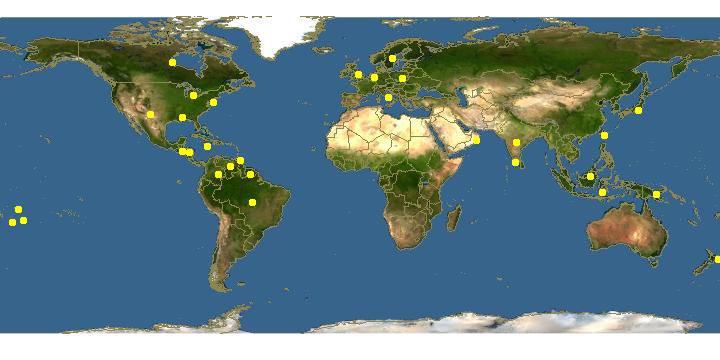
Geographical distribution--further information In addition to the published reports, the following specimens are held in the US National Fungus Collections: Mexico (BPI 596218 and 595433), St Vincent and Grenadines (BPI 596219), Massachusetts and Rhode Island, USA (BPI 595868 and 595867, respectively); and there is an accession from Suriname in the American Type Culture Collection (ATTC 14503). Confirmed isolates of C. fimbriata have also been collected from Iowa (on Carya cordiformis ), Missouri (on Platanus occidentalis ) and Wisconsin, USA (on C. cordiformis ) (TC Harrington, Iowa State University, USA, unpublished data).
Because of the numerous cryptic species in the
C. fimbriata
complex and the history human-mediated movement of host-specialized strains around the world (Baker et al., 2003), it is difficult to know which of the reports of
C. fimbriata
in specific countries are of native populations of
C. fimbriata
or of exotic populations. Thus, many of the above reports have a question mark in the column designating exotic or native. For some of the cases where there is clear evidence that the pathogen was introduced, such as on the ornamental cultivars of
Syngonium
(Walker et al., 1988), it appears that the fungus has been restricted to only cultivated plants in nurseries or greenhouses. Otherwise, the introduced strains are considered to be invasive populations. HISTORY OF INTRODUCTION / SPREAD The Populus form is most abundant in North America, but it has also appeared in Poland and perhaps India, most likely from recent introductions. Cuttings of various Populus species and hybrids were brought into Poland from North America in the 1970s, and C. fimbriata may have been introduced to Poland in these cuttings. Cuttings of P. balsamifera have been shown to harbour the fungus in Quebec nurseries (Vujanovic et al., 1999). The disease was severe in experimental plantings in Poland (Gremmen & de Kam, 1977; Przybyl, 1980, 1986). However, the disease appears to have lessened in importance in recent years and may no longer be present.
The cacao form of the pathogen may have been introduced to the state of Bahia in Brazil on infected cuttings of
Theobroma
cacao
(Harrington 2000; Baker et al., 2003). The recent reports of the eucalyptus form of the pathogen in Uganda and the Congo may also be due to introductions on cuttings from Brazil (Roux et al., 2000, 2001; Baker et al., 2003).
The
Syngonium
form of the pathogen has been dispersed on cuttings of this plant and has been reported in greenhouses in California, Florida, Hawaii and Australia (Davis, 1953; Uchida & Aragaki, 1979; Walker et al., 1988; Alfieri et al., 1994).
The
Ipomoea
form of the fungus has likely been spread to many locations on storage roots. For example, the report of
C. fimbriata
in the Azores (Bensaude, 1927) was on experimental plantings of Ipomoea germplasm imported from the Caribbean. The
Ipomoea
form is apparently native to Latin America and/or the Caribbean (Baker et al., 2003). Although outcrossing is possible, most isolates are self-fertile due to unidirectional mating type switching (Webster and Butler, 1967a, b; Harrington and McNew, 1997; Witthuhn et al., 2000). Fruiting bodies (perithecia) are produced from the mycelium in culture in about a week. The fungus may be dispersed as fragments of mycelium, conidia, aleurioconidia or ascospores. Aleurioconidia are probably the most common survival units because they are thick-walled and durable, and they probably facilitate survival in soil (Accordi, 1989) and in insect frass (Iton, 1960). The fungus may survive in wood fragments in river water (Grosclaude et al., 1991a) and in the soil (Accordi, 1989) for at least 3 months in the winter. C. fimbriata produces a strong fruity odour that varies with the medium. This has been assumed to be an adaptation for dispersal by insects, which are attracted to diseased plants and can become covered with sticky spores if the fungus is sporulating (see Means of Movement and Dispersal). Wounds, either natural or from human activities, are important infection courts for all members of the genus Ceratocystis , including C. fimbriata . Inoculum may reach an open wound by being blown in the wind in insect frass (Iton, 1960) or by being carried by insects that visit the wound. Nitidulid beetles that feed on fungi and plant sap may be important vectors (Moller and DeVay, 1968b). Cultivation practices such as pruning may also provide infection courts (Teviotdale and Harper, 1991). C. fimbriata usually grows best at temperatures from 18 to 28°C and is able to produce ascospores within a week. The fungus probably survives adverse conditions as mycelium within the plant host, or as aleurioconidia in the soil or in plant hosts or debris. The disease in Theobroma has been thought to be most severe during periods of abiotic stresses, particularly drought stress (Spence, 1958), or excessive rain (Malaguti, 1952a). On Ipomoea , attack by C. fimbriata may be enhanced by boron deficiency in the soil (Hu et al., 1999).
Natural dispersal The fungus spreads readily between adjacent Platanus trees via root grafts (Accordi, 1986). It may also infect Platanus trees through wounds in the roots (Vigouroux and Stojadinovic, 1990). Mangifera trees may be infected through the roots from soilborne inoculum (Rossetto and Ribeiro, 1990), and root crops such as Ipomoea are commonly infected through wounds made by insects and rodents (Clark and Moyer, 1988). Ascopores are probably spread naturally by insects and are not likely airborne. Airborne disperal of conidia is also not likely, except in insect frass. Rainsplash dispersal of conidia has not been documented. Vector Transmission Many Ceratocystis species produce fruiting bodies and fruity aromas that are believed to be adaptations for dispersal by insects, and C. fimbriata is frequently associated with insects. On Populus (Hinds, 1972b) and Prunus (Moller and DeVay, 1968b), circumstantial evidence suggests that fungal-feeding nitidulid beetles acquire the fungus and visit fresh wounds on susceptible trees. Also, spores of C. fimbriata may be carried upon the bodies of ambrosia beetles (Iton, 1966), and the spores can survive passage through an insect gut (Iton, 1960, 1966; Crone, 1963). Ambrosia beetles (especially Xyleborus and Hypocryphalus species) are attracted to diseased plants (such as Theobroma , Mangifera and Eucalyptus ) and produce large amounts of fine wood shavings (frass) when creating breeding galleries in the trunk and branches (Goitia and Rosales, 2001). These wood shavings and faecal material are pushed outside the tree as the galleries are excavated, and the frass contains spores and fragments of mycelium that may be blown in the wind (Iton, 1960). Seedborne Spread No instances of its spread on or with seed have been reported. However, one specimen in the US National Fungus Collections (BPI 596218) of an Erythrina seed pod has many fruiting bodies of C. fimbriata , suggesting that seedborne spread is possible. Agricultural Practices Pruning wounds are common entry points for C. fimbriata , and the fungus can be carried on machetes or pruning tools (Walter, 1946, 1952;Teviotdale and Harper, 1991). Platanus street trees may become infected through pruning wounds, and the fungus may be spread on pruning tools or in wound dressings (Walter, 1946). Indeed, proper sanitation and disinfecting tools played a major role in stopping the epidemic on plane trees in urban areas of the eastern USA in the 1920s-1940s (Walter, 1952). Infected wood and sawdust may harbour viable spores for at least 5 years (Grosclaude et al., 1995). On Theobroma , wounds made by harvesting pods, removing stem sprouts or weeding may become infected (Malaguti, 1958), and the fungus also infects pruning wounds and wounds made in harvesting almond fruit (Teviotdale and Harper, 1991).
Movement in Trade It is apparent that several host-specialized forms of the fungus have been introduced into many regions. Propagative materials, especially cuttings, are a likely source. Packaging material and dunnage are also likely means of dispersal of the fungus. The Platanus form may have been introduced on packing material to Europe from North America during World War II (Panconesi, 1981, 1999) and has caused substantial damage to ornamental Platanus in southern Europe. This form can survive in Platanus wood taken from diseased trees (Grosclaude et al., 1995), which may be an efficient means of introducing the pathogen to new locations.
Plant parts liable to carry the pest in trade/transport:
Plant parts not known to carry the pest in trade/transport:
Transport pathways for long distance movement:
Infection of many trees ( Theobroma , Mangifera , Punica and others) is often accompanied by secondary attack by various ambrosia beetles (such as Xyleborus and Hypocryphalus species), which bore into the xylem of the diseased trunk and produce copious amounts of frass (wood particles mixed with faeces) (Iton, 1959, 1960; Rossetto and de Medeiros, 1967; Somasekhara, 1999). Frass may cling to the gallery entrance holes in long strands or accumulate on the bark or at the base of the tree. Aleurioconidia may be present in such frass and may be an important source of inoculum. Frass with C. fimbriata may be dispersed by wind or rainsplash. On rubber trees ( Hevea brasiliensis ), C. fimbriata attacks the tapping panel, causing a pale-grey mould on the surface of the panel and dark discoloration in the wood under the surface (Martin, 1949; Silveira et al., 1994). On herbaceous plants ( Colocasia , Ipomoea , etc.), C. fimbriata may attack through wounded roots or stems, causing a root rot or seedling rot, or it can travel through the xylem, causing rapid wilting of the plant and extensive dark discoloration of the vascular system. It may also occur as a black, sunken rot on the surface of storage roots or corms of Ipomoea and Araceae such as Colocasia and Xanthosoma , either before or after harvest (Clark and Moyer, 1988). The fungus has also been reported as a superficial pathogen of harvested cocoa pods, causing soft, brown, rotted lesions (Malaguti, 1958), especially during rainy periods (Siller, 1958). However, a related fungus, C. paradoxa, is more common on rotten cocoa pods, most likely as a secondary invader (Thorold, 1975). Descriptors: Whole plant: plant dead; dieback; seedling blight; frass visible; wilt. Leaves: necrotic areas; abnormal colours; wilting; yellowed or dead. Stems: discoloration of bark; canker on woody stem; gummosis or resinosis; dieback; mould growth on lesion; internal discoloration; internal feeding; visible frass; wilt; ooze; mycelium present; discoloration. Roots: cortex with lesions. Fruits/pods: lesions: black or brown; lesions: on pods. Click here to see pictures of symptoms caused by C. fimbriata C. fimbriata grows readily on most agar media. Mycelium is hyaline at first, later turning dark greenish-brown. Within a few days there are usually abundant conidiophores that produce chains of hyaline conidia, sometimes called endoconidia, characteristic of the anamorph genus Chalara . However. Chalara species are anamorphs of discomycetes, and the genus Thielaviopsis is now used for anamorphs of Ceratocystis species (Paulin et al., 2002). Endoconidia are cylindrical and may vary in size from 11 to 16 mm long by 4 to 5 mm wide (all measurements are from Hunt, 1956). Specialized conidiophores give rise to thick-walled, pigmented aleurioconidia (sometimes called chlamydospores), probably a survival spore. Aleurioconidia are typically 9-16 mm long and 6-13 mm wide, borne singly or in short chains. Endoconidia may also darken and become thick walled chlamydospores, thus resembling aleurioconidia. Endoconidia, chlamydospores formed from endoconidia, and aleurioconidia may be produced on and within the substratum. The teleomorph of the fungus is well adapted to insect dispersal. The fungus has two mating types, and MAT-1 isolates can only produce perithecia when paired with MAT-2 isolates. However, MAT-2 isolates are self-fertile due to uni-directional mating type switching (Harrington and McNew, 1997; Witthun et al., 2000). Most field isolates are MAT-2 and self-fertile, producing many fruiting bodies (ascomata) on the surface of the host or in culture, often within one week. Ascomata are dark brown to black and globose, 130-200 µm diameter with a long, thin neck up to 800 µm long, through which the ascospores are exuded. The opening at the tip of the neck has 8 to 15 ostiolar hyphae ranging in length from 50 to 90 µm. Ascospores are small, hyaline and hat-shaped, 4.5-8 µm long by 2.5-5.5 µm wide, and accumulate in a sticky matrix at the tip of the ascomatal neck, where they appear as a cream to pink ball or coil.
Click here to see pictures of
C. fimbriata
morphology
Detection and inspection methods
Disease caused by
C. fimbriata
may be visible on cuttings or other plant material as dark discoloration of the xylem, although symptomless cuttings may still be infected. Ascomata may also occasionally be produced on the surface of stem cuttings, particularly at the nodes. On
Ipomoea
storage roots and Araceae corms, the fungus may appear as a dry, black rot, usually with perithecia and ascospores. Incubation of colonized plant parts in a humid environment will usually result in ascomata production in only a few days. Unless perithecia are present on the infected plant, a pure culture of the fungus is usually required for reliable identification. Diagnosis Pure cultures of C. fimbriata may be obtained by placing chips of discoloured wood from the base of an infected tree or diseased vegetative plant parts in a moist chamber or plating them out on nutrient agar. When the fungus is present, conidia appear in 1-3 days and perithecia in 5-10 days. The presence of fast-growing contaminants, such as Fusarium and Penicillium , may necessitate the use of baits. The Platanus form may be baited from wood, soil or water samples with healthy Platanus twigs stripped of their bark (Grosclaude et al., 1988). All forms of the fungus may be baited from infected plant material by placing a small piece of colonized plant material between two slices of fresh carrot in high humidity for 4-10 days (Moller and DeVay, 1968a). Carrot slices may also be used to bait the fungus from soil (Laia et al., 2000), although carrot is not completely species-specific, allowing the growth of C. moniliformis , Thielaviopsis basicola (Yarwood, 1946), Fusarium spp. and some bacteria. The fungus can also be isolated from the frass of ambrosia beetles ( Xyleborus and Hypocryphalus species) in Mangifera , Theobroma and Eucalyptus by using the carrot slice technique.
Molecular or serological diagnostic techniques have not been developed, but there are DNA sequences of ITS-rDNA and other genes unique to
C. fimbriata
, and these could be developed for diagnosis. Similarities to other species or conditions C. fimbriata is usually recognized by its distinctive fruiting bodies, which are somewhat similar to those produced by other species of Ceratocystis and species of Ophiostoma . Ophiostoma species, in contrast to Ceratocystis , do not produce the endoconidial or aleurioconidial states. C. fimbriata has sometimes been confused with Ceratocystis paradoxa , a pathogen of mostly monocotyledonous plants. Both C. paradoxa and C. fimbriata may produce a pod rot of cocoa, although C. fimbriata can be distinguished by its hat-shaped ascospores (Hunt, 1956). Most forms of C.paradoxa are heterothallic, and isolates of this species usually do not produce perithecia unless paired with isolates of opposite mating type. On Theobroma trees, C. fimbriata may be confused with Ceratocystis moniliformis, which is weakly pathogenic, usually causing only partial wilting or wilting of only a few branches (Barba and Hansen, 1962). In the laboratory, C. moniliformis grows much more quickly on nutrient agar than does C. fimbriata , and when viewed under a compound microscope, the perithecial bases of C. moniliformis have characteristic spine-like ornamentations (Hunt, 1956). Also, C. moniliformis does not produce aleurioconidia. However, C. moniliformis produces hat-shaped ascospores similar to those of C. fimbrata .
Infection by many other wilt-type fungi and species of Botryosphaeria may cause xylem discoloration in trees, and it is necessary to isolate C. fimbriata from the discoloured xylem or canker in order to confirm it as the causal agent.
Economic Impact
Environmental impact
Ceratocystis fimbriata
is likely a natural component of many forest ecosystems in the Americas and Asia. On native tree hosts it primarily colonizes wounds but does not move throughout the tree or kill the host. Most mortality of woody hosts appears to be on exotic tree species or native trees in plantations or used as street trees, perhaps because of wounding and movement of the pathogen on tools. The plane tree pathogen, for instance, has been devastating on street trees but rare in natural forests with little human activity (Walter et al., 1952). Even where the fungus has been introduced, the damage is primarily to planted species. Thus, the impact in natural environments has been minimal. However, some plantation species have been abandoned in some regions, such as
Gmelina arborea
in Pará state in Brazil and
Platanus
in the southeastern USA.
Social impact
Host-Plant Resistance
Because most forms of the species are easily transmitted in cuttings, unrestricted movement of cuttings or other propagative material is potentially dangerous. It is likely that the fungus has been spread to new countries or regions on cuttings of
Populus
,
Theobroma
,
Eucalyptus
and
Syngonium
and on storage roots of
Ipomoea
. Circumstantial evidence points to packing materials as the source of the plane tree pathogen in southern Europe, and the fungus is known to survive up to 5 years in wood, probably in the form of aleurioconidia.
Ceratocystis fimbriata
is listed as among the highest risk pathogens that could be imported into the United States on eucalyptus logs and chips from South America (Kliejunas et al., 2001). The
Platanus
form (
C. fimbriata
f.
platani
) is listed as an EPPO A2 quarantine pest (OEPP/EPPO, 1986). To Tom Harrington's Ceratocystis page
|
| Discover Life | Top |
| © Designed by The Polistes Corporation |