D I S C O V E R    L I F E   
Bee Hunt! Odonata Lepidoptera 
  HomeAll Living ThingsIDnature guidesGlobal mapperAlbumsLabelsSearch
  AboutResearchEducationProceedingsPolistes FoundationPartnersLinksHelp

Lonicera japonica Thunb.

Japanese honeysuckle; Chinese honeysuckle; Nintooa japonica Thunb Sweet

Links

80x5 - 240x3 - 240x4 - 320x1 - 320x2 - 320x3 - 640x1 - 640x2
Set display option above.
Click on images to enlarge.
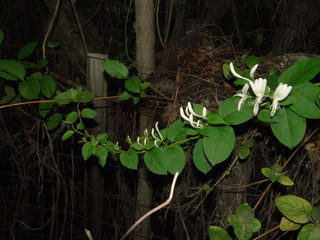
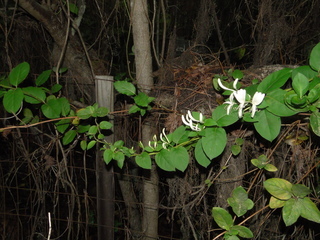
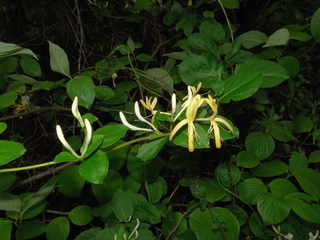
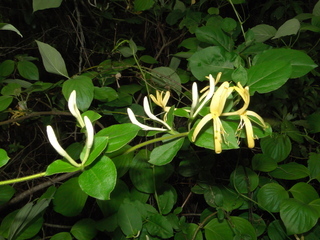
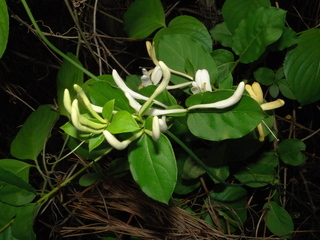
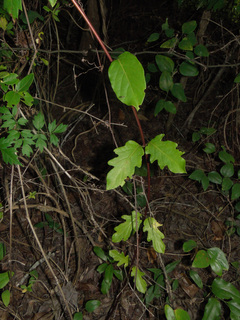
Lonicera japonica, leaf and flower
© Kay Yatskievych, 2003
Lonicera japonica, leaf and flower
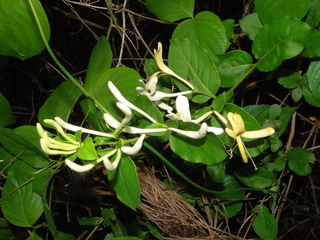
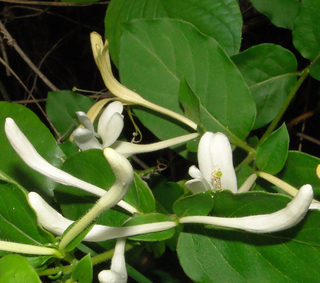
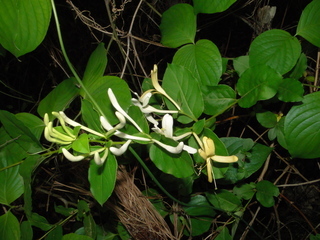
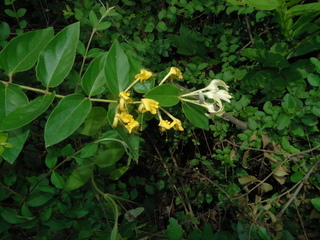
Lonicera japonica, Flower
© Copyright Steve Baskauf, 2002-2005
Lonicera japonica, Flower

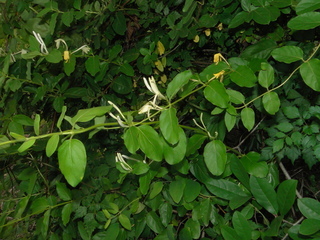
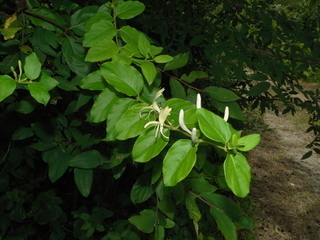
Lonicera japonica, Whole tree
© Copyright Steve Baskauf, 2002-2005
Lonicera japonica, Whole tree
© Copyright Steve Baskauf, 2002-2005
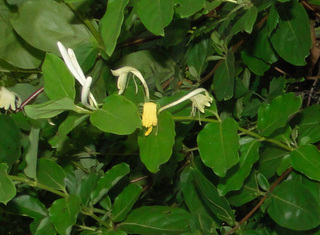
Lonicera japonica, Whole tree

Lonicera japonica, Whole tree
© Copyright Steve Baskauf, 2002-2005
Lonicera japonica, Whole tree
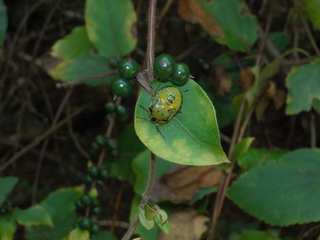
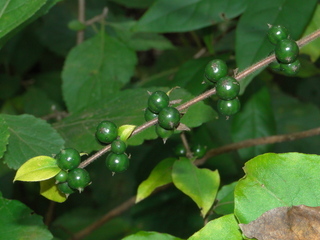
Lonicera japonica, Fruit
© Copyright Steve Baskauf, 2002-2005
Lonicera japonica, Fruit

Lonicera japonica, Fruit
© Copyright Steve Baskauf, 2002-2005
Lonicera japonica, Fruit
Lonicera japonica, Twig
© Copyright Steve Baskauf, 2002-2005
Lonicera japonica, Twig

Lonicera japonica, Bark
© Copyright Steve Baskauf, 2002-2005
Lonicera japonica, Bark
Lonicera japonica, Leaf
© Copyright Steve Baskauf, 2002-2005
Lonicera japonica, Leaf

Lonicera japonica, Twig
© Copyright Steve Baskauf, 2002-2005
Lonicera japonica, Twig
Lonicera japonica, Leaf
© Copyright Steve Baskauf, 2002-2005
Lonicera japonica, Leaf

Lonicera japonica, _berries_and_leaves.JP80279_44.320.jpg
© Photographer/source
Lonicera japonica, berries and leaves
JP80279_44

Names
Scientific source:
      Integrated Taxonomic Information System


Following modified from Virginia Tech Forestry Dept.
   
Top | See original

Following modified from PCA Alien Plant Working Group
   Top | See original

PCA
Fact Sheet Links
Japanese Honeysuckle
Lonicera japonica Thunb.
Honeysuckle family (Caprifoliaceae)
Adobe Acrobat Reader Download PDF version formatted for print (108 KB)

Japanese Honeysuckle NATIVE RANGE
Japan and Korea 

DESCRIPTION
Japanese honeysuckle is a perennial vine that climbs by twisting its stems around vertical structures, including limbs and trunks of shrubs and small trees. Leaves are oblong to oval, sometimes lobed, have short stalks, and occur in pairs along the stem. In southern and mid-Atlantic states, Japanese honeysuckle often remains evergreen – its leaves remain attached through the winter. In colder northern climates, the leaves may fall off after exposure to prolonged winter temperatures. Flowers are tubular, with five fused petals, white to pink, turning yellow with age, very fragrant, and occur in pairs along the stem at leaf junctures. Stems and leaves are sometimes covered with fine, soft hairs. Japanese honeysuckle blooms from late April through July and sometimes into October. Small black fruits are produced in autumn, each containing 2-3 oval to oblong, dark brown seeds about 1/4 inch across. 

ECOLOGICAL THREAT
In North America, Japanese honeysuckle has few natural enemies which allows it to spread widely and out-compete native plant species. Its evergreen to semi-evergreen nature gives it an added advantage over native species in many areas. Shrubs and young trees can be killed by girdling when vines twist tightly around stems and trunks, cutting off the flow of water through the plant. Dense growths of honeysuckle covering vegetation can gradually kill plants by blocking sunlight from reaching their leaves. Vigorous root competition also helps Japanese honeysuckle spread and displace neighboring native vegetation. 

Click for distribution map of Japanese honeysuckle. DISTRIBUTION IN THE UNITED STATES
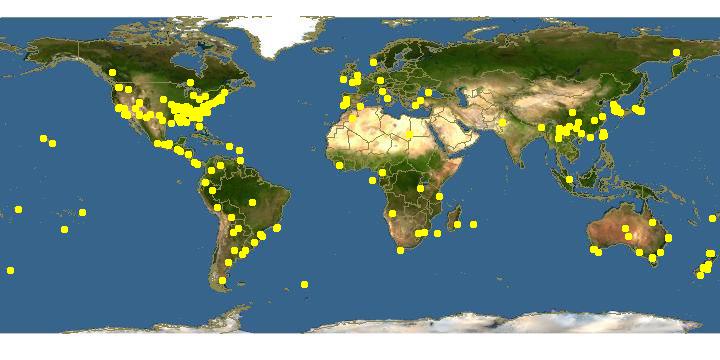
Japanese honeysuckle occurs across the southern U.S. from California to New England and the Great Lakes region. Escaped populations also occur in Hawaii. Severe winter temperatures and low precipitation may limit its distribution in northern latitudes and in the West, respectively.

HABITAT IN THE UNITED STATES
A ubiquitous invader, Japanese honeysuckle thrives in a wide variety of habitats including fields, forests, wetlands, barrens, and all types of disturbed lands. 

BACKGROUND
Japanese honeysuckle was introduced to the U.S. in the early to mid-1800's as an ornamental plant, for erosion control, and for wildlife forage and cover. Its highly fragrant flowers provide a tiny drop of honey-flavored nectar enjoyed by children. 

BIOLOGY & SPREAD
Growth and spread of Japanese honeysuckle is through vegetative (plant growth) and sexual (seed) means. It produces long vegetative runners that develop roots where stem and leaf junctions (nodes) come in contact with moist soil. Underground stems (rhizomes) help to establish and spread the plant locally. Long distance dispersal is by birds and other wildlife that readily consume the fruits and defecate the seeds at various distances from the parent plant. 

MANAGEMENT OPTIONS
Several effective methods of control are available for Japanese honeysuckle, including chemical and non-chemical, depending on the extent of the infestation and available time and labor.

Manual and Mechanical
For small patches, repeated pulling of entire vines and root systems may be effective. Hand pull seedlings and young plants when the soil is moist, holding low on the stem to remove the whole plant along with its roots. Monitor frequently and remove any new plants. Cut and remove twining vines to prevent them from girdling and killing shrubs and other plants. An effective method for removal of patches of honeysuckle covering the ground is to lift up and hold a portion of the vine mass with a rake and have a chain saw operator cut the stems low to the ground. Mowing large patches of honeysuckle may be useful if repeated regularly but is most effective when combined with herbicide application (see below). Mow at twice a year, first in mid-July and again in mid-September. Plants can also be grubbed out using a pulaski or similar digging tool, taking care to remove all roots and runners. Burning removes above ground vegetation but does not kill the underground rhizomes, which will continue to sprout. In certain situations, tethered goats have been used to remove honeysuckle growth, but must be monitored to prevent their escape to the wild where they would become an added ecological threat.

Chemical
In moderate cold climates, Japanese honeysuckle leaves continue to photosynthesize long after most other plants have lost their leaves. This allows for application of herbicides when many native species are dormant. However, for effective control with herbicides, healthy green leaves must be present at application time and temperatures must be sufficient for plant activity. Several systemic herbicides (e.g., glyphosate and triclopyr) move through the plant to the roots when applied to the leaves or stems and have been used effectively on Japanese honeysuckle.

Following label guidelines, apply a 2.5% rate of glyphosate (e.g., Rodeo® for wetlands; Roundup® for uplands) mixed with water and an appropriate surfactant, to foliage from spring through fall. Alternatively, apply a 2% concentration of triclopyr (e.g., Garlon 3A) plus water to foliage, thoroughly wetting the leaves but not to the point of drip-off. A coarse, low-pressure spray should be used. Repeat applications may be needed. Treatment in the fall, when many non-target plants are going dormant, is best. Also, a 25% glyphosate or triclopyr solution mixed with water can be applied to cut stem surfaces any time of year as long as the ground is not frozen.

Biological
No biological control agents are currently available for Japanese honeysuckle.

USE PESTICIDES WISELY: ALWAYS READ THE ENTIRE PESTICIDE LABEL CAREFULLY, FOLLOW ALL MIXING AND APPLICATION INSTRUCTIONS AND WEAR ALL RECOMMENDED PERSONAL PROTECTIVE GEAR AND CLOTHING. CONTACT YOUR STATE DEPARTMENT OF AGRICULTURE FOR ANY ADDITIONAL PESTICIDE USE REQUIREMENTS, RESTRICTIONS OR RECOMMENDATIONS. 

NOTICE: MENTION OF PESTICIDE PRODUCTS ON THIS WEB SITE DOES NOT CONSTITUTE ENDORSEMENT OF ANY MATERIAL.

CONTACTS
For more information on the management of Japanese honeysuckle, please contact:

  • Lisa Jameson, National Park Service, Washington, DC, lisa_jameson at nps.gov
  • Corey Kudrna, National Park Service, Washington, DC, corey_kudrna at nps.gov
  • Vikki Nuzzo, Cornell University, vnuzzo at earthlink.net
  • Ann Rhoads, University of PA, Morris Arboretum, rhoadsaf at pobox.upenn.edu
  • Sue Salmons, National Park Service, sue_salmons at nps.gov

SUGGESTED ALTERNATIVE PLANTS
Vines that make good substitutes for Japanese honeysuckle include false jasmine ( Gelsemium sempervirens ), trumpet honeysuckle ( Lonicera sempervirens ), trumpet creeper ( Campsis radicans ), crossvine ( Bignonia capreolata ), native wisteria ( Wisteria frutescens ), jackman clematis ( Clematis jackmanii ), and others. Check with your state native plant society, a reputable native plant nursery, for recommendations for plants that are appropriate for your area and conditions.

OTHER LINKS


AUTHOR
Melissa A. Bravo, National Park Service, Roosevelt-Vanderbilt National Historic Sites, Hyde Park, NY

EDITOR
Jil M. Swearingen, National Park Service, Center for Urban Ecology, Washington, DC

REVIEWERS
Sylvan Kaufman, Adkins Arboretum, Ridgely, MD
Corey Kudrna, National Park Service, Washington, DC
Vikki Nuzzo, Cornell University, Ithaca, NY

PHOTOGRAPH
Jil M. Swearingen, National Park Service, Center for Urban Ecology, Washington, DC

REFERENCES
Barden, L. S. and J. F. Matthews. 1980. Change in abundance of honeysuckle ( Lonicera japonica ) and other ground flora after prescribed burning of a piedmont pine forest. Castanea 45: 257-260.

Dillenberg L.R., D.F. Whigham, A.H. Teramura, I.N. Forseth. 1993. Effects of below- and aboveground competition from the vines Lonicera japonica and Parthenocissus quinquefolia on the growth of the tree host Liquadambar stryraciflua . Oecologia 93:48-54.

Fernald, M. L. 1989. Grays Manual of Botany. Biosystematics, Floristic and Phylogeny Series. Volume 2. T. R. Dudley, Editor. Dioscorides Press. Portland, OR. 1,632 pp.

Gleason H. A. and A. Cronquist. The Illustrated Companion to Gleason and Cronquist's Manual of Vascular Plants of Northeastern United States and adjacent Canada. New York Botanic Garden, New York, NY. 937 pp.

Kartesz, J. and C. Meacham Synthesis of the North American Flora.

Nuzzo, V. Japanese honeysuckle. Element stewardship abstract for Lonicera japonica . The Nature Conservancy. 1815 North Lynn Street, Arlington VA, 22209. http://www.imapinvasives.org/GIST/ESA/ . Last updated April 15, 1997.

Regehr, D. L. and D. R. Frey. 1988. Selective control of Japanese honeysuckle ( Lonicera japonica ). Weed Technology 2:139-143.

Rhoads, A. F. and T. H. Block. 2002. The Plants of Pennsylvania, An Illustrated Manual. Morris Arboretum of the University of Pennsylvania. University of Pennsylvania Press, Philadelphia, PA. 1060 pp.

Swearingen, J. 2009. WeedUS Database of Plants Invading Natural Areas in the United States: Japanese Honeysuckle ( Lonicera japonica ). http://www.invasive.org/weedus/subject.html?sub=3039.

USDA, NRCS. 2009. The PLANTS Database (http://plants.usda.gov). National Plant Data Center, Baton Rouge, LA 70874-4490 USA.

Virginia Native Plant Society VA NHP Japanese Honeysuckle Fact Sheet
http://www.vnps.org/invasive/invloni.htm


Plant Conservation Alliance, Alien Plant Working Group.

FACT SHEET LIST | APWG HOME PAGE

Comments, suggestions, and questions about the website should be directed to the webmaster .
http://www.nps.gov/plants/alien/fact/loja1.htm
Last updated:07-Jul-2009

Following modified from Plants Database, United States Department of Agriculture
   Top | See original

Link: Skip repetitive navigation links
USDA and NRCS Identifier NRCS Logo
USDA.gov Web Site PLANTS photo banner
PLANTS Home  about PLANTS  PLANTS Team  Partners of PLANTS  What  National Plant Data Center Web Site  Help using PLANTS  Contact PLANTS
 
 Search the PLANTS Web site
 Name Search

 State Search
 Advanced Search
 Search Help
PLANTS Topics
 
 Alternative Crops
 Characteristics
 Classification
 Culturally Significant
 Distribution Update
 Fact Sheets & Plant Guides
 Invasive and Noxious Weeds
 Links
 Plant Materials Publications
 Threatened & Endangered
 Wetland Indicator Status
 
PLANTS Image Gallery
 
 40,000+ Plant Images
 Submit Your Digital Images
 
Download PLANTS data
 
 Complete PLANTS Checklist
 State PLANTS Checklist
 Advanced Search Download
 Symbols for Unknown Plants
 NRCS State GSAT Lists
 NRCS State Plants Lists
 PLANTS Posters
 
Related tools
 
 Crop Nutrient Tool
 Ecological Site Information System
 PLANTS Identification Keys
 Plant Materials Web Site
 Other NRCS Tech
Resources
 VegSpec
 
 
You are here: Home / PLANTS Profile Printer-Friendly Printer-Friendly / Plug-Ins
PLANTS Profile
Alaska Colorado Idaho Iowa Minnesota Montana North Dakota Oregon South Dakota Vermont Washington Wyoming Virgin Islands Alberta British Columbia Manitoba New Brunswick Labrador Newfoundland Nova Scotia Prince Edward Island Quebec Saskatchewan Yukon Northwest Territories Nunavut Greenland Saint Pierre and Miquelon


Lonicera japonica Thunb.
Japanese honeysuckle

       
Symbol:   LOJA  
Group:   Dicot  
Family:   Caprifoliaceae  
Duration:   Perennial  
Growth Habit:   Vine  
Native Status:  
L48    I
HI    I
PR    I
CAN    I


Click on the image below to enlarge it and download a high-resolution JPEG file.
Photo of Lonicera japonica Thunb.
Robert H. Mohlenbrock. USDA SCS. 1991. Southern wetland flora: Field office guide to plant species . South National Technical Center, Fort Worth. Courtesy of USDA NRCS Wetland Science Institute . Usage Requirements .
 
More Information:
 

Images:
Lonicera japonica Thunb.

Click on a thumbnail to view an image, or see all the Lonicera thumbnails at the PLANTS Gallery
View a larger version of this image and Profile page for Lonicera japonica Thunb. View a larger version of this image and Profile page for Lonicera japonica Thunb. View a larger version of this image and Profile page for Lonicera japonica Thunb. View a larger version of this image and Profile page for Lonicera japonica Thunb. View a larger version of this image and Profile page for Lonicera japonica Thunb. View a larger version of this image and Profile page for Lonicera japonica Thunb. View a larger version of this image and Profile page for Lonicera japonica Thunb. View a larger version of this image and Profile page for Lonicera japonica Thunb. View a larger version of this image and Profile page for Lonicera japonica Thunb. View a larger version of this image and Profile page for Lonicera japonica Thunb. View a larger version of this image and Profile page for Lonicera japonica Thunb. View a larger version of this image and Profile page for Lonicera japonica Thunb. View a larger version of this image and Profile page for Lonicera japonica Thunb. View a larger version of this image and Profile page for Lonicera japonica Thunb. View a larger version of this image and Profile page for Lonicera japonica Thunb. View a larger version of this image and Profile page for Lonicera japonica Thunb. View a larger version of this image and Profile page for Lonicera japonica Thunb. View a larger version of this image and Profile page for Lonicera japonica Thunb. View a larger version of this image and Profile page for Lonicera japonica Thunb. View a larger version of this image and Profile page for Lonicera japonica Thunb.
 

Synonyms:
Lonicera japonica Thunb.

  LOJAA2 Lonicera japonica Thunb. var. aureo-reticulata (T. Moore) G. Nicholson
  LOJAC Lonicera japonica Thunb. var. chinensis (P.W. Watson) Baker
  NIJA Nintooa japonica (Thunb.) Sweet
 

Distribution:
Lonicera japonica Thunb.

View Native Status
Distribution Map Legend

See U.S. county distributions (when available) by clicking on the map or the linked states below:

USA ( AL , AR , AZ , CA , CT , DC , DE, FL , GA , HI , IL , IN , KS , KY , LA , MA , MD, ME , MI , MO , MS , NC , NE , NH , NJ , NM , NV , NY , OH , OK , PA , RI , SC , TN , TX , UT , VA , WI, WV ), USA+ (PR), CAN (ON)
 

Related Taxa:
Lonicera japonica Thunb.

View 11 genera in Caprifoliaceae , 52 species in Lonicera
 

Classification:
Lonicera japonica Thunb.

Click on a scientific name below to expand it in the PLANTS Classification Report.
   
Kingdom Plantae – Plants
Subkingdom Tracheobionta – Vascular plants
Superdivision Spermatophyta – Seed plants
Division Magnoliophyta – Flowering plants
Class Magnoliopsida – Dicotyledons
Subclass Asteridae
Order Dipsacales
Family Caprifoliaceae – Honeysuckle family
Genus Lonicera L. – honeysuckle
Species Lonicera japonica Thunb. – Japanese honeysuckle
 

Noxious Weed Information:
Lonicera japonica Thunb.

This plant is listed by the U.S. federal government or a state. Common names are from state and federal lists. Click on a place name to get a complete noxious weed list for that location, or click here for a composite list of all Federal and State Noxious Weeds .

Connecticut :
Japanese honeysuckle              Invasive, banned
Massachusetts :
Japanese honeysuckle              Prohibited
New Hampshire :
Japanese honeysuckle              Prohibited invasive Species
Vermont :
Japanese honeysuckle              Class B noxious weed
 

U.S. Weed Information:
Lonicera japonica Thunb.

Chinese honeysuckle
Japanese honeysuckle

This plant can be weedy or invasive according to the authoritative sources noted below. This plant may be known by one or more common names in different places, and some are listed above. Click on an acronym to view each weed list, or click here for a composite list of Weeds of the U.S.

STATE        Assorted authors. 200_. State noxious weed lists for 46 states . State agriculture or natural resource departments.
FLEPPC        Florida Exotic Pest Plant Council. 1999. Invasive plant list (19 October 1999). Florida Exotic Pest Plant Council. Florida.
HEAR        USDI, Geological Survey. 1999. Information index for selected alien plants in Hawaii (20 October 2003). Hawaiian Ecosystems at Risk Project, Biological Resources Division, Haleakala Field Station. Makawao, Hawaii.
N'EAST        Uva, R.H., J.C. Neal, & J.M. DiTomaso. 1997. Weeds of the Northeast . Cornell University Press. Ithaca, New York. 397pp.
SEEPPC        Southeast Exotic Pest Plant Council. 1996. Invasive exotic pest plants in Tennessee (19 October 1999). Research Committee of the Tennessee Exotic Pest Plant Council. Tennessee.
SWSS        Southern Weed Science Society. 1998. Weeds of the United States and Canada. CD-ROM . Southern Weed Science Society. Champaign, Illinois.
WI        Hoffman, R. & K. Kearns (eds.). 1997. Wisconsin manual of control recommendations for ecologically invasive plants . Wisconsin Dept. Natural Resources. Madison, Wisconsin. 102pp.
 

Introduced Information:
Lonicera japonica Thunb.

This plant is introduced to some part of the PLANTS Floristic Area, though it may be native in other parts. Click on link below for a partial or complete list of PFA introduced plants.

Scientific Name= A | B | C | D | E | F | G | H | I | J | K | L | M | N | O | P | Q | R | S | T | U | V | W | X | Y | Z | all
Common Name= A | B | C | D | E | F | G | H | I | J | K | L | M | N | O | P | Q | R | S | T | U | V | W | X | Y | Z | all
 

Wetland Indicator Status:
Lonicera japonica Thunb.

Nat. Ind. Reg. 1 Reg. 2 Reg. 3 Reg. 4 Reg. 5 Reg. 6 Reg. 7 Reg. 8 Reg. 9 Reg. 0 Reg. A Reg. C Reg. H
FACU,FAC+ FAC- FAC- FACU NO FACU FAC FACU* FAC+ NO NI NO FAC NO
Interpreting Wetland Indicator Status
 

Wildlife Habitat Values:
Lonicera japonica Thunb.

  Large Mammals Small Mammals Water Birds Terrestrial Birds
Source Large Mammals Food Large Mammals Cover Small Mammals Food Small Mammals Cover Water Birds Food Water Birds Cover Terrestrial Birds Food Terrestrial Birds Cover
Martin Minor   Minor Moderate     Minor Moderate
Miller Low   Low Moderate     Low Moderate
Yarrow Moderate Moderate   Moderate     Low Moderate
Wildlife Habitat Values


Martin, A.C., H.S. Zim, and A.L. Nelson. 1951. American wildlife and plants: A guide to wildlife food habits . Dover Publications, New York.

Miller, J.H., and K.V. Miller. 1999. Forest plants of the southeast and their wildlife uses . Southern Weed Science Society.

Yarrow, G.K., and D.T. Yarrow. 1999. Managing wildlife . Sweet Water Press, Birmingham.


More Accounts and Images:
Lonicera japonica Thunb.

View photographs from CalPhotos.

View species account from USDA Forest Service Fire Effects Information System (FEIS).

View species account , photographs , and distribution from USF Atlas of Florida Vascular Plants.

View species account from ARS Germplasm Resources Information Network (GRIN).

View taxonomic account from Integrated Taxonomic Information System (ITIS) for ITIS Taxonomic Serial Number 35283.

View species account and distribution map from Jepson Interchange (University of California - Berkeley).

View species account from Native American Ethnobotany (University of Michigan - Dearborn).

View photographs and distribution from University of Tennessee Herbarium.

View species account and photographs from University of Wisconsin - Stevens Point Freckmann Herbarium.


Related Web Sites:
Lonicera japonica Thunb.

CT-Invasive Plant Species Identification Sheets (USDA NRCS)

Hawaiian Ecosystems at Risk: Plant Threats to Pacific Ecosystems

IL-Vegetation Management Guidelines (Nature Preserve Commission)

ME-Invasive Plant Fact Sheets (DNR)

MO-Missouri Vegetation Management Manual

NPCI Alien Plant Working Group: abstract & image

NY-Invasive Plant Council of New York State-Top 20

New Zealand Environment Bay of Plenty: abstract & images

The Nature Conservancy: Wildland Weeds Management & Research Program

University of Hawaii Botany Department: Alien Plants of Hawaii

VA-Invasive Alien Plant Species of Virginia


Time Generated: 11/21/2009 02:54 PM MST  

 PLANTS Home | USDA.gov | NRCS | Site Map | Policies and Links
Accessibility Statement | Privacy Policy | Non-Discrimination Statement

Following modified from Flora of Taiwan, National Taiwan University
   Top | See original

¦æ¬F°|°ê®a¬ì¾Ç©e­û·| °ê¥ß»OÆW¤j¾Ç °ê¥ß»OÆW¤j¾Ç¥ÍºA¾Ç»Pºt¤Æ¥Íª«¾Ç¬ã¨s©Ò ¶ð¤s¦ÛµM¹êÅç«Ç ¼Æ¦ì¨åÂðê®a«¬¬ì§Þ­pµe »OÆW¤j¾Ç¨åÂÃ¼Æ¦ì¤Æ­pµe

  PREV     NEXT      Photo375      PL342  

  PREV     NEXT      Photo375      PL342  


TAI Systems --- an implement of UDTH

tech support --- TNL

Following modified from Plants Database, United States Department of Agriculture
   Top | See original

Link: Skip repetitive navigation links
USDA and NRCS Identifier NRCS Logo
USDA.gov Web Site PLANTS photo banner
PLANTS Home  about PLANTS  PLANTS Team  Partners of PLANTS  What  National Plant Data Center Web Site  Help using PLANTS  Contact PLANTS
 
 Search the PLANTS Web site
 Name Search

 State Search
 Advanced Search
 Search Help
PLANTS Topics
 
 Alternative Crops
 Characteristics
 Classification
 Culturally Significant
 Distribution Update
 Fact Sheets & Plant Guides
 Invasive and Noxious Weeds
 Links
 Plant Materials Publications
 Threatened & Endangered
 Wetland Indicator Status
 
PLANTS Image Gallery
 
 40,000+ Plant Images
 Submit Your Digital Images
 
Download PLANTS data
 
 Complete PLANTS Checklist
 State PLANTS Checklist
 Advanced Search Download
 Symbols for Unknown Plants
 NRCS State GSAT Lists
 NRCS State Plants Lists
 PLANTS Posters
 
Related tools
 
 Crop Nutrient Tool
 Ecological Site Information System
 PLANTS Identification Keys
 Plant Materials Web Site
 Other NRCS Tech
Resources
 VegSpec
 
 
You are here: Home / PLANTS Profile Printer-Friendly Printer-Friendly / Plug-Ins
PLANTS Profile
Alaska Colorado Idaho Iowa Minnesota Montana North Dakota Oregon South Dakota Vermont Washington Wyoming Virgin Islands Alberta British Columbia Manitoba New Brunswick Labrador Newfoundland Nova Scotia Prince Edward Island Quebec Saskatchewan Yukon Northwest Territories Nunavut Greenland Saint Pierre and Miquelon


Lonicera japonica Thunb.
Japanese honeysuckle

       
Symbol:   LOJA  
Group:   Dicot  
Family:   Caprifoliaceae  
Duration:   Perennial  
Growth Habit:   Vine  
Native Status:  
L48    I
HI    I
PR    I
CAN    I


Click on the image below to enlarge it and download a high-resolution JPEG file.
Photo of Lonicera japonica Thunb.
Robert H. Mohlenbrock. USDA SCS. 1991. Southern wetland flora: Field office guide to plant species . South National Technical Center, Fort Worth. Courtesy of USDA NRCS Wetland Science Institute . Usage Requirements .
 
More Information:
 

Images:
Lonicera japonica Thunb.

Click on a thumbnail to view an image, or see all the Lonicera thumbnails at the PLANTS Gallery
View a larger version of this image and Profile page for Lonicera japonica Thunb. View a larger version of this image and Profile page for Lonicera japonica Thunb. View a larger version of this image and Profile page for Lonicera japonica Thunb. View a larger version of this image and Profile page for Lonicera japonica Thunb. View a larger version of this image and Profile page for Lonicera japonica Thunb. View a larger version of this image and Profile page for Lonicera japonica Thunb. View a larger version of this image and Profile page for Lonicera japonica Thunb. View a larger version of this image and Profile page for Lonicera japonica Thunb. View a larger version of this image and Profile page for Lonicera japonica Thunb. View a larger version of this image and Profile page for Lonicera japonica Thunb. View a larger version of this image and Profile page for Lonicera japonica Thunb. View a larger version of this image and Profile page for Lonicera japonica Thunb. View a larger version of this image and Profile page for Lonicera japonica Thunb. View a larger version of this image and Profile page for Lonicera japonica Thunb. View a larger version of this image and Profile page for Lonicera japonica Thunb. View a larger version of this image and Profile page for Lonicera japonica Thunb. View a larger version of this image and Profile page for Lonicera japonica Thunb. View a larger version of this image and Profile page for Lonicera japonica Thunb. View a larger version of this image and Profile page for Lonicera japonica Thunb. View a larger version of this image and Profile page for Lonicera japonica Thunb.
 

Synonyms:
Lonicera japonica Thunb.

  LOJAA2 Lonicera japonica Thunb. var. aureo-reticulata (T. Moore) G. Nicholson
  LOJAC Lonicera japonica Thunb. var. chinensis (P.W. Watson) Baker
  NIJA Nintooa japonica (Thunb.) Sweet
 

Distribution:
Lonicera japonica Thunb.

View Native Status
Distribution Map Legend

See U.S. county distributions (when available) by clicking on the map or the linked states below:

USA ( AL , AR , AZ , CA , CT , DC , DE, FL , GA , HI , IL , IN , KS , KY , LA , MA , MD, ME , MI , MO , MS , NC , NE , NH , NJ , NM , NV , NY , OH , OK , PA , RI , SC , TN , TX , UT , VA , WI, WV ), USA+ (PR), CAN (ON)
 

Related Taxa:
Lonicera japonica Thunb.

View 11 genera in Caprifoliaceae , 52 species in Lonicera
 

Classification:
Lonicera japonica Thunb.

Click on a scientific name below to expand it in the PLANTS Classification Report.
   
Kingdom Plantae – Plants
Subkingdom Tracheobionta – Vascular plants
Superdivision Spermatophyta – Seed plants
Division Magnoliophyta – Flowering plants
Class Magnoliopsida – Dicotyledons
Subclass Asteridae
Order Dipsacales
Family Caprifoliaceae – Honeysuckle family
Genus Lonicera L. – honeysuckle
Species Lonicera japonica Thunb. – Japanese honeysuckle
 

Noxious Weed Information:
Lonicera japonica Thunb.

This plant is listed by the U.S. federal government or a state. Common names are from state and federal lists. Click on a place name to get a complete noxious weed list for that location, or click here for a composite list of all Federal and State Noxious Weeds .

Connecticut :
Japanese honeysuckle              Invasive, banned
Massachusetts :
Japanese honeysuckle              Prohibited
New Hampshire :
Japanese honeysuckle              Prohibited invasive Species
Vermont :
Japanese honeysuckle              Class B noxious weed
 

U.S. Weed Information:
Lonicera japonica Thunb.

Chinese honeysuckle
Japanese honeysuckle

This plant can be weedy or invasive according to the authoritative sources noted below. This plant may be known by one or more common names in different places, and some are listed above. Click on an acronym to view each weed list, or click here for a composite list of Weeds of the U.S.

STATE        Assorted authors. 200_. State noxious weed lists for 46 states . State agriculture or natural resource departments.
FLEPPC        Florida Exotic Pest Plant Council. 1999. Invasive plant list (19 October 1999). Florida Exotic Pest Plant Council. Florida.
HEAR        USDI, Geological Survey. 1999. Information index for selected alien plants in Hawaii (20 October 2003). Hawaiian Ecosystems at Risk Project, Biological Resources Division, Haleakala Field Station. Makawao, Hawaii.
N'EAST        Uva, R.H., J.C. Neal, & J.M. DiTomaso. 1997. Weeds of the Northeast . Cornell University Press. Ithaca, New York. 397pp.
SEEPPC        Southeast Exotic Pest Plant Council. 1996. Invasive exotic pest plants in Tennessee (19 October 1999). Research Committee of the Tennessee Exotic Pest Plant Council. Tennessee.
SWSS        Southern Weed Science Society. 1998. Weeds of the United States and Canada. CD-ROM . Southern Weed Science Society. Champaign, Illinois.
WI        Hoffman, R. & K. Kearns (eds.). 1997. Wisconsin manual of control recommendations for ecologically invasive plants . Wisconsin Dept. Natural Resources. Madison, Wisconsin. 102pp.
 

Introduced Information:
Lonicera japonica Thunb.

This plant is introduced to some part of the PLANTS Floristic Area, though it may be native in other parts. Click on link below for a partial or complete list of PFA introduced plants.

Scientific Name= A | B | C | D | E | F | G | H | I | J | K | L | M | N | O | P | Q | R | S | T | U | V | W | X | Y | Z | all
Common Name= A | B | C | D | E | F | G | H | I | J | K | L | M | N | O | P | Q | R | S | T | U | V | W | X | Y | Z | all
 

Wetland Indicator Status:
Lonicera japonica Thunb.

Nat. Ind. Reg. 1 Reg. 2 Reg. 3 Reg. 4 Reg. 5 Reg. 6 Reg. 7 Reg. 8 Reg. 9 Reg. 0 Reg. A Reg. C Reg. H
FACU,FAC+ FAC- FAC- FACU NO FACU FAC FACU* FAC+ NO NI NO FAC NO
Interpreting Wetland Indicator Status
 

Wildlife Habitat Values:
Lonicera japonica Thunb.

  Large Mammals Small Mammals Water Birds Terrestrial Birds
Source Large Mammals Food Large Mammals Cover Small Mammals Food Small Mammals Cover Water Birds Food Water Birds Cover Terrestrial Birds Food Terrestrial Birds Cover
Martin Minor   Minor Moderate     Minor Moderate
Miller Low   Low Moderate     Low Moderate
Yarrow Moderate Moderate   Moderate     Low Moderate
Wildlife Habitat Values


Martin, A.C., H.S. Zim, and A.L. Nelson. 1951. American wildlife and plants: A guide to wildlife food habits . Dover Publications, New York.

Miller, J.H., and K.V. Miller. 1999. Forest plants of the southeast and their wildlife uses . Southern Weed Science Society.

Yarrow, G.K., and D.T. Yarrow. 1999. Managing wildlife . Sweet Water Press, Birmingham.


More Accounts and Images:
Lonicera japonica Thunb.

View photographs from CalPhotos.

View species account from USDA Forest Service Fire Effects Information System (FEIS).

View species account , photographs , and distribution from USF Atlas of Florida Vascular Plants.

View species account from ARS Germplasm Resources Information Network (GRIN).

View taxonomic account from Integrated Taxonomic Information System (ITIS) for ITIS Taxonomic Serial Number 35283.

View species account and distribution map from Jepson Interchange (University of California - Berkeley).

View species account from Native American Ethnobotany (University of Michigan - Dearborn).

View photographs and distribution from University of Tennessee Herbarium.

View species account and photographs from University of Wisconsin - Stevens Point Freckmann Herbarium.


Related Web Sites:
Lonicera japonica Thunb.

CT-Invasive Plant Species Identification Sheets (USDA NRCS)

Hawaiian Ecosystems at Risk: Plant Threats to Pacific Ecosystems

IL-Vegetation Management Guidelines (Nature Preserve Commission)

ME-Invasive Plant Fact Sheets (DNR)

MO-Missouri Vegetation Management Manual

NPCI Alien Plant Working Group: abstract & image

NY-Invasive Plant Council of New York State-Top 20

New Zealand Environment Bay of Plenty: abstract & images

The Nature Conservancy: Wildland Weeds Management & Research Program

University of Hawaii Botany Department: Alien Plants of Hawaii

VA-Invasive Alien Plant Species of Virginia


Time Generated: 11/21/2009 02:54 PM MST  

 PLANTS Home | USDA.gov | NRCS | Site Map | Policies and Links
Accessibility Statement | Privacy Policy | Non-Discrimination Statement

Following modified from Global Invasive Species Database
   Top | See original

* * * * *  
* * * * * *
*
* * *  
* * * *
*
* border border
*
Global Invasive Species Database 100 of the worst Donations home
*
Standard Search Standard Search Taxonomic Search   Index Search
*
*

    Lonicera japonica (vine, climber)   français  
Ecology Distribution Management
Info
Impact
Info
References
and Links
Contacts * *


       Japanese honeysuckle spiral trunk damage to the invasive plant Ligustrum vulgare (Photo: Martin Kohl) - Click for full size    Japanese honeysuckle spiral trunk damage to the invasive plant Ligustrum vulgare (Photo: Martin Kohl) - Click for full size    Japanese honeysuckle with toothed leaves (Photo: Martin Kohl) - Click for full size    Japanese honeysuckle thriving in Tennessee (Photo: Martin Kohl) - Click for full size
    Taxonomic name: Lonicera japonica Thunb.
    Synonyms: Caprifolium hallianum Hort., Lonicera brachypoda DC., Lonicera flexuosa Thun., Lonicera japonica var. chinensis , Lonicera japonica var. chinensis (P.W. Wats.) Baker, Nintooa japonica , Nintooa japonica (Thunb.) Sweet
    Common names: chèvrefeuille (French-Reunion (La Réunion)), chèvrefeuille du Japon (French), Chinese honeysuckle (English), Hall's honeysuckle (English), Japanese honeysuckle (English), Japanisches Geissblatt (German), madreselva (Dominican Republic), madressilva (Portuguese-Brazil)
    Organism type: vine, climber
    Lonicera japonica is an extremely vigorous vine which grows up through the canopy, smothering and ultimately killing the host tree. It competes with native plants for light and nutrients and prevents the understorey and small trees from developing, causing a reduction in forest diversity. Lonicera japonica is shade and drought tolerant, though it needs full to partial sunlight to grow successfully. It spreads rapidly via above-ground runners that root at nodes and its seeds may be eaten by birds and then dispersed. It is planted in gardens and along roadsides for landscaping purposes and can also be spread by the dumping of garden waste.
    Description
    Lonicera japonica is an evergreen in its southern range and semi-evergreen in its northern range. Stems are hollow with peeling reddish-brown bark and usually 2 to 3m long when developed. Leaves are 4 to 8cm long and ovate in shape. L. japonica produces white to yellowish tubular flowers that are 2.5 to 5cm long and black berries that contain 2 to 12 seeds. The seeds are 2 to 3mm long, ovate in shape, and dark brown to black in colour. Flowers are produced during summer and “fruit mature and are dispersed during autumn in eastern United States" (Hidayati et al . 2000). The blooming period extends from April to December in Georgia (Andrews 1919), late May to October in Kentucky (Nuzzo 1997), May to June in Illinois (Mohlenbrock 1986), and June in Michigan (Nuzzo 1997).
    Occurs in:
    natural forests, ruderal/disturbed, urban areas
    Habitat description
    Lonicera japonica is found in a variety of habitats, including fields, forest edges and openings, disturbed woods, and floodplains. It is shade and drought tolerant, though it needs full to partial sunlight to grow successfully. L. japonica is still planted in gardens and along roadsides for landscaping purposes.
    General impacts
    L. japonica competes with natives for light and nutrients. It outcompetes natives by spreading rapidly and completely covering and toppling small trees and shrubs in the process. This prevents the understory and small trees from developing, causing a reduction in forest understory diversity. The newly opened understory causes L. japonica to spread rapidly and provide habitat to other invasives, such as Hedera helix (English ivy) and Pueraria montana (kudzu).
    Uses
    L. japonica is beneficial as winter forage for white tail deer and is used for this purpose by wildlife managers. Birds and cotton-tailed rabbits also eat the seeds and leaves of the vine. It provides a habitat cover of twisted vines for birds and small mammals. Landscapers use it because of its fragrant smell. It is considered a valuable medical herb in China, where it is used to treat chicken pox and to maintain human vascular homeostasis.
    Geographical range
    Native range : L. japonica is native to Japan and Korea.
    Known introduced range : It has been introduced to the United States, Hong Kong, England, Wales, Portugal, Brazil, Argentina, and Corsica.
    Introduction pathways to new locations
    Landscape/fauna "improvement": It's planted along roadsides and in gardens for landscaping purposes.


    Local dispersal methods
    Consumption/excretion: Seeds may be eaten by birds and then dispersed.
    Garden escape/garden waste: Can be spread by dumping of garden waste
    Natural dispersal (local): Spreads via above ground runners that root at nodes.
    Other (local): The vine is moving northward in the USA, possibly because it is adjusting to colder temperatures.
    Management information
    Preventative measures : A Risk Assessment of Lonicera japonica for Hawai‘i and other Pacific islands was prepared by Dr. Curtis Daehler (UH Botany) with funding from the Kaulunani Urban Forestry Program and US Forest Service. The alien plant screening system is derived from Pheloung et al . (1999) with minor modifications for use in Pacific islands (Daehler et al. 2004). The result is a score of 12 and a recommendation of: "Likely to cause significant ecological or economic harm in Hawai‘i and on other Pacific Islands as determined by a high WRA score, which is based on published sources describing species biology and behaviour in Hawai‘i and/or other parts of the world."

    Physical : Mowing and grazing control the spread of L. japonica , however, this does not eradicate it. Prescribed burns remove aboveground vegetation and reduce new growth but do not destroy roots, which will continue to produce sprouts.

    Chemical : Chemical control is effective if used in the correct concentration and applied at the appropriate time of year. An effective treatment appears to be a foliar spray of 1.5% glyphosate applied shortly after the first frost.

    Integrated management : The most effective eradication technique seems to be a combination of both herbicide application and burning. The evergreen nature of the plant throughout its range allows it to photosynthesize longer, providing it with a competitive advantage over other plants that go dormant earlier. But fortunately, this also allows for easier identification, assessment and treatment among dormant native plants.

    Reproduction
    Lonicera japonica reproduces vegetatively and by seed. Seeds are spread mostly by birds, which ingest the berries and excrete the seeds. L. japonica plants spread by way of aboveground runners that root at the nodes. The plants are pollinated by a variety of insects, such as bumblebees, butterflies, and especially hawkmoths, but in some areas may produce few fruits and seeds (Larson et al . 2002). Seeds require cold stratification to overcome dormancy (Hidayati et al. 2000). L. japonica produces 2 to 12 seeds per berry.
    Lifecycle stages
    Lonicera japonica has an extended growing season, owing to its evergreen nature.
    Reviewed by: Dr. Katherine C. Larson, Associate Professor of Biology; University of Central Arkansas Conway, USA Dr. Siti N. Hidayati, Adjunct Professor of Biology; Department of Biology Middle Tennessee State Uni
    Compiled by: National Biological Information Infrastructure (NBII) & IUCN/SSC Invasive Species Specialist Group (ISSG)
    Last Modified: Wednesday, 16 November 2005


issg logo logo nbii logo iucn logo uoa logo
The Global Invasive Species Database is managed by the Invasive Species Specialist Group (ISSG) of the IUCN Species Survival Commission. It was developed as part of the global initiative on invasive species led by the Global Invasive Species Programme (GISP) and is supported through partnerships with the National Biological Information Infrastructure, Manaaki Whenua-Landcare Research and the University of Auckland. Conditions of use .
border
border border border

Following modified from Taiwan Biodiversity National Information Network
   Top | See original

 
Kingdom Plantae  
 Phylum Magnoliophyta  
 Class Magnoliopsida  
 Order Dipsacales  
 Family Caprifoliaceae  
 Genus Lonicera  
  Lonicera japonica    Thunb., 1784 
Provider: Ching-I Peng 
hierarchy tree    download xml    download txt    Chinese Page    
Synonyms: Lonicera japonica chinensis Nintooa japonica details
Citation: Flora of Taiwan 2nd ed. 4: 744, 1998 
Name Code: 202813
Suggested Link    Discover Life    National Plant Genetic Resources Center    Flora of Taiwan 2nd eBooks (National Taiwan University)  
User Response:   æä¾›ç‰©ç¨®è³‡è¨Š    æä¾›ç‰©ç¨®ç…§ç‰‡
 
Previous Page       Home Page

Following modified from CalPhotos
   Top | See original


CalPhotos     Photo Database


Number of matches : 3
Query: SELECT * FROM img WHERE ready=1 and taxon like "Lonicera japonica%" and (lifeform != "specimen_tag" OR lifeform != "Plant") ORDER BY taxon

Click on the thumbnail to see an enlargement

Lonicera japonica
Lonicera japonica
Chinese Honeysuckle
ID: 0000 0000 0405 1752 [detail]
© 2005 Lisa Powers

Lonicera japonica
Lonicera japonica
Japanese Honeysuckle
ID: 0000 0000 1208 2880 [detail]
© 2008 Neal Kramer

Lonicera japonica
Lonicera japonica
Japanese Honeysuckle
ID: 0000 0000 0909 0437 [detail]
© 2009 Neal Kramer

Using these photos: A variety of organizations and individuals have contributed photographs to CalPhotos. Please follow the usage guidelines provided with each image. Use and copyright information, as well as other details about the photo such as the date and the location, are available by clicking on the [detail] link under the thumbnail. See also: Using the Photos in CalPhotos .   


Copyright © 1995-2009 UC Regents. All rights reserved.

CalPhotos is a project of BSCIT     University of California, Berkeley

Updated: 2009-11-21 21:56:25 gmt
Discover Life | Top
© Designed by The Polistes Corporation