|
| Links | Extracted from: Sheffield C. S., et al (2011). Leaf cutter and Mason Bees of the Genus Megachile Latreille (Hymenoptera; Megachilidae) in Canada and Alaska. Canadian Journal of Arthropod Identification No. 18 Megachile (Litomegachile) mendica Cresson, 1878 Megachle mendica Cresson, 1878. Trans. Amer. Entomol. Soc. 7: 126 (♀). Megachile mendica snowi Mitchell, 1927. Psyche 34: 113 (♀). Diagnosis. The female of M. mendica can be recognized by the combination of 4-dentate mandibles, with the emargination between inner and 3rd teeth with an angulation (appearing as a weakly developed 5th tooth), T6 being nearly straight in lateral view, S6 with scopal hairs mostly pale, and S1-S5 with scopal hairs yellow. They are most similar to M. gentilis. The female of M. gentilis has T6 slightly concave in lateral view, S6 with entirely black scopal hairs, and S1-S5 with scopal hairs white. The male can be recognized by the combination of simple and dark front tarsi, front coxa possessing a small spine, 3-dentate mandibles, T5 lacking a white apical fascia, and T4-T5 with punctures separated with distinct, polished interspaces that are separated by 2-4 pd.. They are most similar to M. gentilis. The male of M. gentilis has T4-T5 with punctures close with interspaces indistinct. FEMALE: Length 11-13 mm. Head. 1) compound eyes very slightly convergent below; lateral ocelli subequally distant from eyes and margin of vertex, 2) clypeal margin straight and entire, 3) mandibles 4-dentate, with an incomplete cutting edge between 2nd and 3rd teeth, complete between 3rd and 4th teeth, but emargination between 3rd and 4th teeth slightly angulate, thus approaching a weakly developed 5th tooth occupying proximal half of the emargination (Plate 1, Figure M11), 4) gena narrower than compound eye, (3:4), 5) punctures deep and distinct, rather fine, quite close but not crowded across vertex, becoming more fine, shallow and close on gena, frons more rugose, clypeus and supraclypeal area shining, punctures well separated medially, becoming quite close on each side, 6) pubescence whitish, quite copious and rather elongate around antennae and paraocular area, on gena below, becoming rather sparse above, pubescence of vertex black, 7) F1 subequal in length to pedicel and F2, remaining flagellomeres slightly longer than broad (2.5:2), apical flagellomere more elongate (3.5:2). Mesosoma. 1) pubescence mostly pale, rather sparse laterally and posteriorly, hardly concealing surface, mesoscutum and scutellum largely black pubescent, 2) mesoscutum and scutellum rather dull, punctures fine and crowded, slightly separated anteriorly in centre of mesoscutum, quite densely crowded on axilla, scutellum and pleura above, propodeum somewhat smoother with finer punctures and larger interspaces (1-2 pd), triangle dull and impunctate, 3) mid and hind basitarsi slightly narrower than their tibiae, spurs pale yellow, 4) tegula minutely and rather closely punctate, 5) wings sub-hyaline, veins black. Metasoma. 1) T2-T5 shallowly grooved across base, basal margin of the groove slightly carinate and complete, apical margins narrowly depressed laterally but not medially, narrowly white fasciate, fasciae more or less interrupted on the more basal terga, discal pubescence short, erect, rather dense, entirely black on T2-T5, T1 with rather sparse but long and erect, entirely pale pubescence, without a distinct apical fascia; terga shining, punctures fine and well separated medially, becoming somewhat closer laterally; T6 straight in profile, with no erect hairs evident, but some erect, rather sparse pubescence evident toward sides in dorsal view, surface very densely and finely punctate and more or less covered with brown, appressed tomentum, 2) S6 rather sparsely covered with scopal hairs, the more apical of these black, scopa otherwise yellow; S1 and S2 quite closely, uniformly punctate, S3-S5 more coarsely and sparsely so, apical margins very narrowly yellowish-hyaline. MALE: Length 8-10 mm. Head. 1) compound eyes slightly convergent below; distance from lateral ocelli to margin of vertex subequal to distance to eyes, 2) clypeal margin nearly straight, but median third very slightly produced, shining and impunctate, very slightly incurved, 3) mandible 3-dentate, lower process triangular, basal in position, 4) gena very slightly narrower than compound eye, 5) punctures deep and distinct, rather fine, slightly separated across vertex, becoming somewhat finer and more shallow and vague on gena, densely crowded on frons, entire face around and below antennae densely and finely rugose beneath dense pubescence that completely hides surface, clypeus densely and finely punctate throughout, 6) pubescence of face yellowish-white, that on gena greyish-white, quite copious and elongate below, becoming somewhat more yellowish and with a few, intermixed, dark hairs on vertex, 7) F1 about as long as broad and subequal in length to pedicel, half as long as F2 and remaining flagellomeres, which are longer than broad (5:3), apical flagellomere more elongate (4:1.5). Mesosoma. 1) pubescence greyish-white laterally and posteriorly, becoming somewhat more yellowish, with a few intermixed dark hairs on mesoscutum, 2) mesoscutum dull, punctures rather fine and densely crowded except in apical half in centre where they are slightly separated, those on axilla and scutellum very densely crowded; pleura dull, subrugose, punctures closely crowded; propodeum somewhat smoother, with close minute, shallow and obscure punctures, triangle dull and impunctate, 3) front coxal spine well developed, quite slender and elongate, densely long pubescent posteriorly; mid tibial spur rather short but well developed; all basitarsi much narrower than their respective tibiae, spurs yellow, 4) tegula shining, very minutely and rather closely punctate, 5) wings subhyaline, veins more brownish-black. Metasoma. 1) T2-T4 rather deeply grooved toward base, with a distinct carina and narrow pale tomentum arising from carina, apical margins very narrowly depressed, especially laterally, very narrowly yellowish-hyaline; punctures of T1 and T2 very fine and close, uniform, somewhat coarser and well separated medially on T3 and T4, becoming slightly closer laterally, apical margin of T4 depressed across entire width; T5 with pale tomentum across base, apical margin very deeply and narrowly depressed, T5 not fasciate, punctures elongate basal to apical depression, rather coarse and close apically; T6 densely pale tomentose medially, carina with a deep, evenly rounded emargination, margin on each side very minutely crenulate, median teeth of apical margin fully as near each other as each one is to the lateral tooth, 2) S1-S4 exposed, apical margins of S2-S4 depressed with hyaline margins; punctures fine and close with shiny interspaces <1 pd, S1 well covered with white elongate pubescence, discal pubescence of S2-S4 very sparse, hardly visible, S2 and S3 with white apical fasciae, S4 without fascia. Genitalia. Plate 2, Figure G11. Discussion. Megachile mendica is a common eastern species. It nests in soil, but has also been reported accepting trap-nests (Table 1). Baker et al. (1985) provide illustrations for the immature stages. Distribution: Eastern Canada in QC and ON and BC in the west (see Map 11).
- Hosts
|
80x5 -
240x3 -
240x4 -
320x1 -
320x2 -
320x3 -
640x1 -
640x2
Set display option above.
Click on
images to enlarge. |
© Copyright source/photographer
· 9
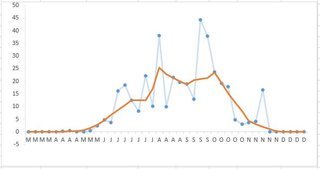
Megachile mendica, Mid-Atlantic Phenology |
Smithsonian Institution, Entomology Department · 9
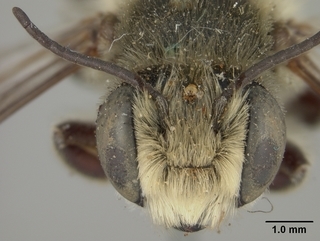
Megachile mendica, male, face |
|
Smithsonian Institution, Entomology Department · 9
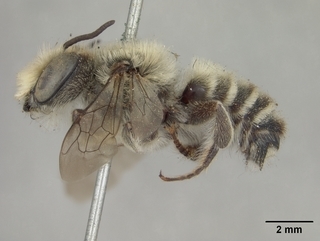
Megachile mendica, male, side |
Smithsonian Institution, Entomology Department · 9
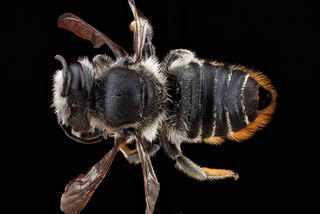
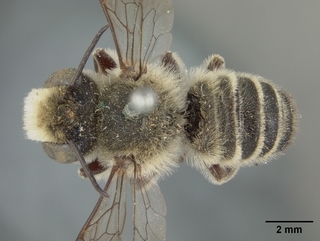
Megachile mendica, male, top |
|
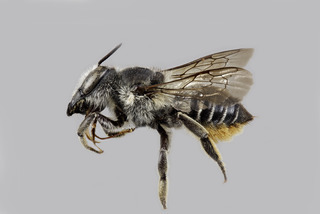
© Copyright Laurence Packer 2014
· 7
Megachile mendica FEM comp |
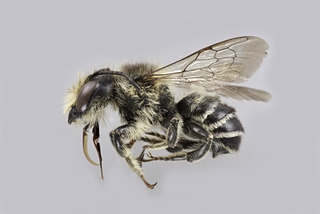
© Copyright Laurence Packer 2014
· 7
Megachile mendica MALE comp |
|
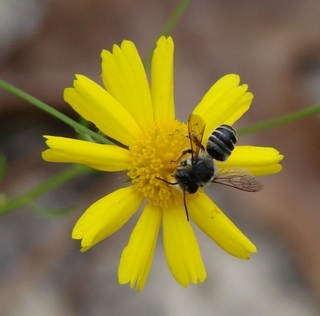
© Copyright John Ascher, 2006-2014
· 6
Megachile mendica |
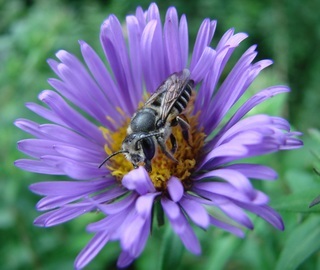
© Copyright John Ascher, 2006-2014
· 6
Megachile mendica, Flat-tailed Leafcutter |
|
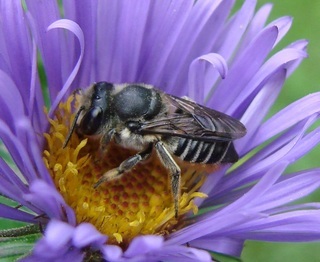
© Copyright John Ascher, 2006-2014
· 6
Megachile mendica, Flat-tailed Leafcutter |
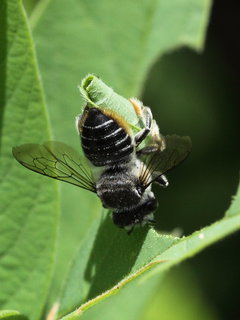
Michael Veit · 6
Megachile mendica, f cutting Desmodium |
|
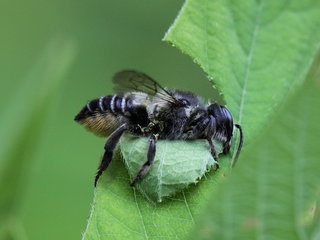
Michael Veit · 6
Megachile mendica, f cutting Desmodium |
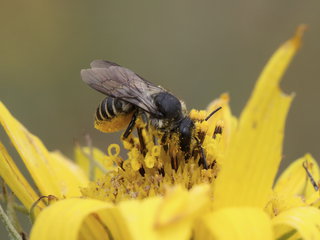
Michael Veit · 6
Megachile mendica, f on Helianth -- |
|
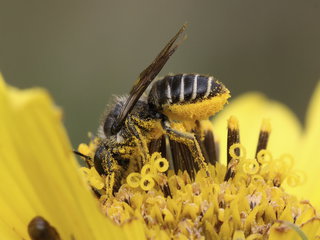
Michael Veit · 6
Megachile mendica, f on Helianth -- |
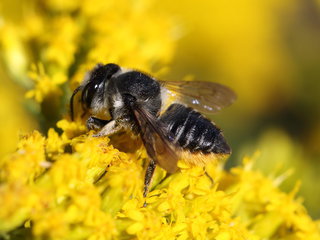
Michael Veit · 6
Megachile mendica, f on Solidago -- |
|
Overview |
Reprinted with permission from: Mitchell, T.B. 1962 Bees of the Eastern United States. North Carolina Agricultural Experiment Station Technical Bulletin No. 152.
FEMALE�Length 11-13 mm.; black, including tegulae and legs, spurs pale yellow; eyes very slightly convergent below; clypeal margin straight and entire; mandibles 4-dentate, but emargination between 3rd and 4th teeth slightly angulate, bevelled edges between 2nd and 3rd, and 3rd and 4th (fig. 38); lateral ocelli subequally distant from eyes and margin of vertex; cheeks below subequal to eyes in width, narrowed above; punctures deep and distinct, rather fine, quite close but not crowded across vertex, becoming more fine, shallow and close on cheeks, face below ocelli more rugose, clypeus and supraclypeal area shining, punctures well separated medially, becoming quite close on each side; pubescence whitish, quite copious and rather elongate around antennae and along inner margins of eyes, on cheeks below, becoming rather thin above, and over lateral and posterior areas of thorax, the vertex, scutum and scutellum largely black pubescent; scutum and scutellum rather dull, punctures in general fine and crowded, slightly separated in center of scutum, quite densely crowded on axillae, scutellum and pleura, propodeum somewhat smoother; mid and hind basitarsi slightly narrower than their tibiae; tegulae minutely and rather closely punctate; wings sub-hyaline, veins piceous; abdominal terga 2-5 shallowly grooved across base, basal margin of the groove slightly carinate and complete, apical margins narrowly depressed laterally but not medially, narrowly white fasciate, fasciae more or less interrupted on the more basal terga, discal pubescence short, erect, rather dense, entirely black on terga 2-5, basal tergum with rather thin but long and erect, entirely pale pubescence, without a distinct apical fascia; terga shining, punctures fine and well separated medially, becoming somewhat closer laterally; terguni 6 straight in profile, with no erect hairs evident, but some erect,rather sparse pubescence evident toward sides in dorsal view, surface very densely and finely punctate and more or less covered with fuscous, appressed tomentum; sternum 6 rather thinly covered with scopal hairs, the more apical of these black, scopa otherwise yellow; sterna 1 and 2 quite closely, uniformly punctate, 3-5 more coarsely and sparsely so, apical margins very narrowly yellowish-hyaline.
MALE�Length 8-10 mm.; entirely black, including tegulae and legs, spurs yellow; eyes slightly convergent below; clypeal margin nearly straight, but median third very slightly produced, shining and impunctate, very slightly incurved; mandible 3-dentate (fig. 38), with a triangular, basal, inferior process; apical segment of flagellum slender and elongate; lateral ocelli slightly nearer eyes than to margin of vertex; cheeks very slightly narrower than eyes; punctures deep and distinct, rather fine, slightly separated across vertex, becoming somewhat finer and more shallow and vague on cheeks, densely crowded below ocelli, entire face around and below antennae densely and finely rugose beneath dense pubescence which completely hides surface; pubescence of face yellowish-white, that on cheeks greyish-white, quite copious and elongate below, greyish-white on thorax laterally and posteriorly, becoming somewhat more yellowish and with a few, intermixed, dark hairs on vertex and scutum; scutum dull, punctures rather fine and densely crowded except near center where they are very slightly separated, those on axillae and scutellum very densely crowd2d; pleura dull, subrugose, punctures closely crowded; propodeum somewhat smoother, with close minute, shallow and obscure punctures; front coxal spines well developed, quite slender and elongate, densely long pubescent posteriorly; mid tibial spurs rather short but well developed; all basitarsi much narrower than their respective tibiae; tegulae shining, very minutely and rather closely punctate; wings subhyaline, veins more brownish-piceous; abdominal terga 2-4 rather deeply grooved toward base of each, apical margins very narrowly depressed, especially laterally, very narrowly yellowish-hyaline; punctures of terga 1 and 2 very fine and close, uniform, somewhat coarser and well separated medially on 3 and 4, becoming slightly closer laterally, apical margin of 4 depressed across entire width; tergum 5 narrowly pale tomentose across base, apical margin very deeply and narrowly depressed, not fasciate, punctures rather coarse and close throughout; tergum 6 densely pale tomentose medially, carina with a deep, evenly rounded emargination, margin on each side very minutely erenulate, median teeth of apical margin fully as near each other as each one is to the lateral tooth;setose area of sternum 5 restricted, setae minute (fig. 36); sternum 6 with a single, transverse row of robust, curved setae on each side, other setae minute, apical lobe broad and short, lateral angles acute; gonocoxites of genital armature narrowed above base, compressed apically, apex subacute and flexed (fig. 37).
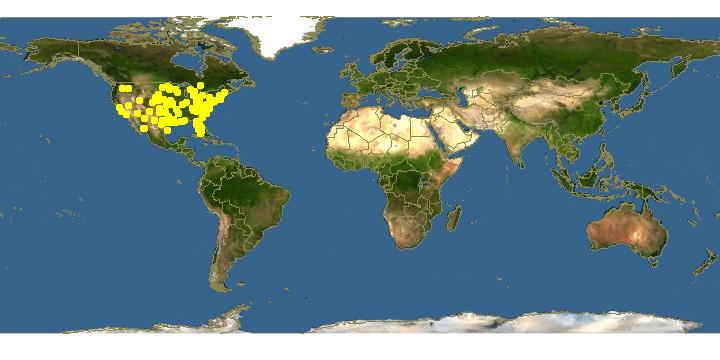
DISTRIBUTION�This is a widely distributed species in the United States, occurring from coast to coast, and from Maine to Florida in the East. It is in flight throughout the season.
FLOWER RECORDS�Amorpha, Aralia, Asciepias, Aster, Baptisia, Bidens, Bornchia, Ceanothus, Cephalant hue, Chrysanthemum, Chrysopsis, Cicuta, Cirsium, Clematie, Cosmos, Crataegus, Crotalania, Daucus, Enigeron, Eriogonum, Eupatonium, Flavenia, Galactia, Gerardia, Haplopappus, Helenium, Helianthus, Hypenicum, flex, Itea, Linaria, Medicago, Melilotus, Monarda, Nyssa, Ocimum, Oenothera, Opuntia, Phaseolus, Polygonum, Rhus, Riehardia, Rubus, Rudbeckia, Senecio, Solidago, Speculana, Spiraea, Stachys, Suriana, Tephrosict, Tnifolium, Trilisa, Vaccinium, Veronica, Vicia and Zinnia. Additional records by Robertson (1929) include the following:
Acerates, Agastache, Apios, Blephilia, Boltonia, Brauneria, Camassia, Cassia, Coreopsis, Desmodium, Diospyros, Eryngium, Gaura, Impatiens, Lepachys, Lespedeza, Lycopus, Lythrum, Nepeta, Prunella, Peedera, Psoralea, Pycnanth emum, Rosa, Salix,Sliphium, Strophostyles, Symphoricarpus, Teucrium, Verbena and Verb esina. Three additional records are given by Michener (1947), Cyrilla, Gaylussacia and Pyrrhopappus.
|
|
|
Identification | |
Male Megachile brevis and Megachile mendica are not currently distinguishable.
Extracted from: Robertson, C. (1897). North American Bees - Description and Synonyms. Transactions of the Academy of Science of St. Louis. Vol. 7. No. 14.
♂.- The male of this species closely resembles that of M.
brevis, but is distinguished as follows : larger, vertex mesonotum and segments 2-5 of abdomen with black : hairs, abdomen
more sparsely punctured, edge of sixth segment with the two
median teeth sloping away rather equally on each side, about
as near to each other as to the lateral teeth, or nearer,
pubescence above yellowish or even fulvous varying to
whitish. Length 9-11 mm.
|
|
|
Names | |
|
|
| Supported by | |
Updated: 2024-04-17 00:22:29 gmt
|