Michael Veit · 6
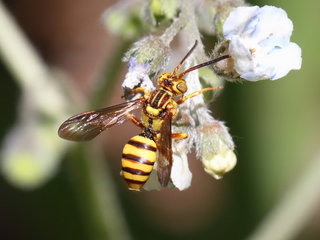
Nomada luteola, f on Comfrey -- |
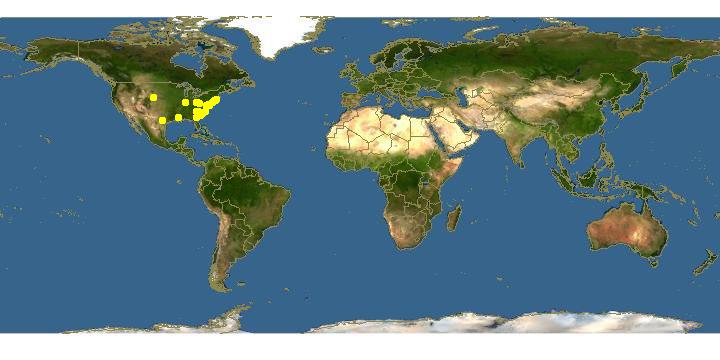
Click on map for details about points.
|
80x5 -
240x3 -
240x4 -
320x1 -
320x2 -
320x3 -
640x1 -
640x2
Set display option above.
Click on
images to enlarge. |
Michael Veit · 6
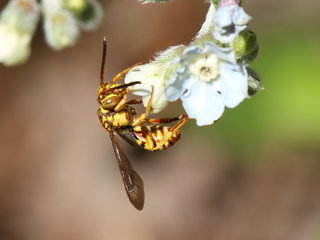
Nomada luteola, f on Comfrey -- |
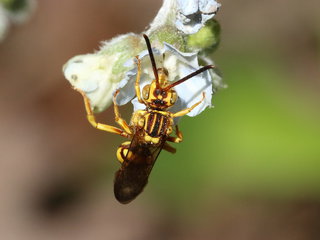
Michael Veit · 6
Nomada luteola, f on Comfrey -- |
|
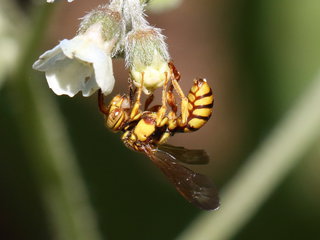
Michael Veit · 6
Nomada luteola, f on Comfrey -- |
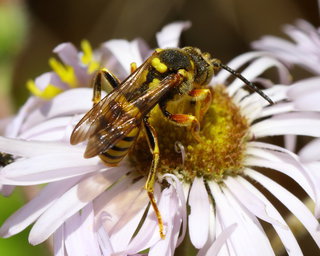
Michael Veit · 6
Nomada luteola, m on -- |
|
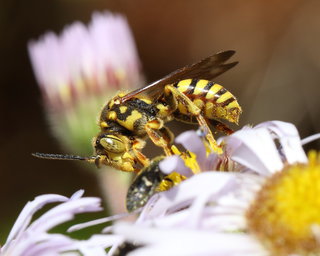
Michael Veit · 6
Nomada luteola, m on -- |
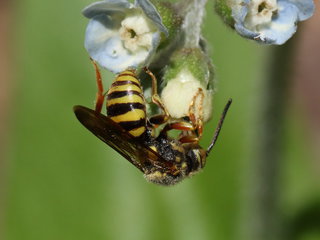
Michael Veit · 6
Nomada luteola, M on Comfrey -- |
|
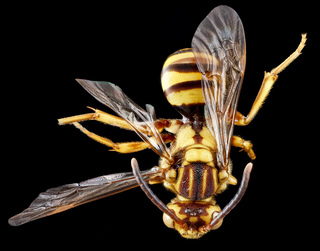
© Copyright source/photographer
· 5
Nomada luteola, F, back, Maryland, Somerset County |
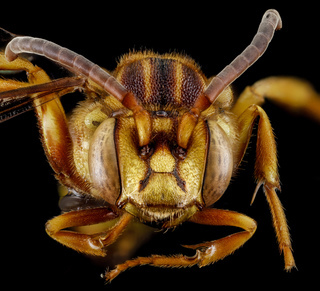
© Copyright source/photographer
· 5
Nomada luteola, F, face, Maryland, Somerset County |
|
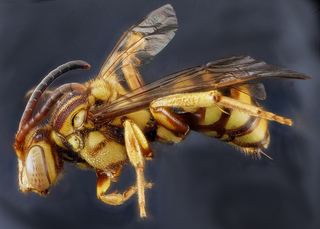
© Copyright source/photographer
· 5
Nomada luteola, F, side, Maryland, Somerset County |
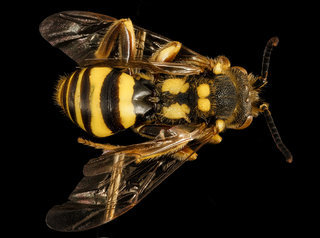
© Copyright source/photographer
· 5
Nomada luteola, m, back, Maryland |
|
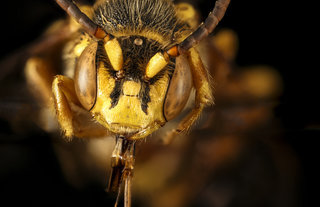
© Copyright source/photographer
· 5
Nomada luteola, m, face, Maryland |
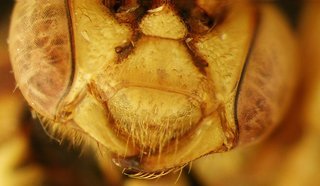
© Mary Paul
· 1
Nomada luteola, male, labrum2 |
|
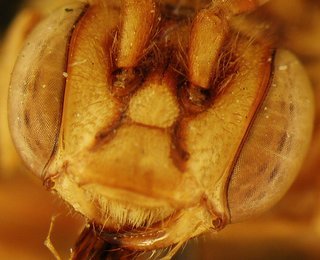
© Mary Paul
· 1
Nomada luteola, female, cheek |
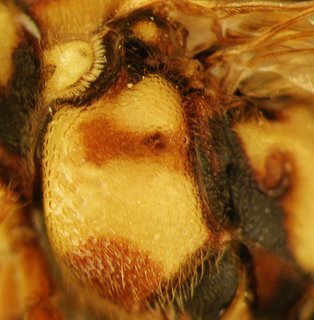
© Mary Paul
· 1
Nomada luteola, femalle, yellow mesepisturnum |
|
Overview |
Reprinted with permission from: Mitchell, T.B. 1962 Bees of the Eastern United States. North Carolina Agricultural Experiment Station Technical Bulletin No. 152.
FEMALE � Length 9.5-13 mm.; lateral ocelli slightly nearer margin of vertex than to each other; cheeks very slightly narrower than eyes, posterior margin sharply carinate; shorter side of basal segment of flagellum more than half the length of segment 2, longer side not equalling segment 2 in length, median segments somewhat longer than broad; mandibles slender and simple apically; wings subhyaline basally, becoming rather deeply infuscated apically and in marginal cell, with the usual three submarginal cells, 2nd somewhat broader anteriorly than 3rd, veins testaceous to piceous, basal vein slightly basad of transverse median; tegulae shining between deep, distinct, rather coarse and close punctures; posterior margin of scutellum quite deeply grooved medially; front coxae not spined; apex of hind tibiae with a row of 7 or 8 robust, yellowish bristles; face and cheeks large part yellow, with a limited amount black above each antennae and around ocelIi, these separated by a transverse yellow band, vertex and posterior margin of cheeks some degree ferruginous; antennal scape yellowish anteriorly, becoming reddish to piceous posteriorly, basal segment of flagellum somewhat more reddish, the more apical segments piceous; pronotal collar, tubercles, tegulae, lateral margins of scutum, axillae, scutellum, adjacent median area of metanotum, posterior face of propodeum in large part, and upper half of mesopleura, bright yellow; scutum with a median black line slightly separated from a pair of narrow yellow lines by ferruginous, and a broad band of ferruginous between the median and lateral yellow lines; propodeum narrowly black medially, the lateral faces and metapleura largely black; mesopleura below ferruginous; coxae in part yellow, with some ferruginous infusions; trochanters testaceous, the femora testaceous basally, becoming more or less yellow apically; tibiae yellow at base and apex, more or less infused with testaceous medially; tarsi yellow-testaceous, the spurs pale yellow; basal abdominal tergum with a broad, transverse, yellow band, piceous basally, the impressed, apical margin ferruginous; discs of terga 2-5 yellow in large part, the apical impressed areas ferruginous; abdominal sterna yellow in large part, apical, impressed areas more testaceous-hyaline; punctures deep, distinct and quite close over most of head, very coarse and quite distinct laterally and above, much finer and closer on cheeks, supraclypeal area and clypeus; scutum, scutellum and mesopleura coarsely rugoso-punctate, punctures of scutellum crowded but distinct; posterior face of propodeum with scattered, irregular, rather shallow, coarse punctures, these becoming closer on lateral faces above, shining and rather smooth below, triangle impunctate but rather dull, becoming very short striate above; abdominal terga very finely, closely and uniformly punctate throughout, punctures almost crowded, only the very narrow apical rims impunctate; pseudopygidium transverse, very short, forming the rather broad, apical margin of tergum 5, densely covered with suberect silvery tomentum; pubescence very short, thin and inconspicuous throughout, somewhat yellowish, very obscure on abdomen dorsally, hairs somewhat more elongate beneath; apex of sternum 5 with a pair of tufts of elongate yellowish hairs that converge medially.
MALE�Length 9-13.5 mm.; lateral ocelli subequally distant from margin of vertex and each other; cheeks somewhat narrower than eyes, posterior margin strongly carinate; antennal scape swollen, apex quite deeply excavated, partially enclosing pedicel, basal segment of flagellum very short, the shorter side no more than half the length of segment 2, median segments somewhat longer than broad; mandibles slender and simple apically; wings hyaline basally, becoming lightly infuscated apically and in marginal cell, with the usual three submarginal cells, 2nd only slightly broader than 3rd anteriorly, veins testaceous to brownish, basal vein slightly basad of transverse median; tegulae shining between close, deep and distinct punctures; posterior margin of scutellum slightly grooved medially; front coxae not spinose; hind femora unmodified; face largely yellow below level of antennae, the supraclypeal area and upper half of clypeus narrowly bordered with black, cheeks quite broadly yellow just back of eye, a small yellow spot below anterior ocellus and a similar spot above each eye; face above antennae, vertex and cheeks posteriorly black, the lateral maculae ending rather narrowly on margin of eye slightly above antennae; antennal scape yellow anteriorly, piceous posteriorly, flagellum brownish-testaceous below, piceous above; pronotal collar, tubercles, tegulae, axillae, scutellum, adjacent median area of metanotum in part, a pair of broad, quadrangular maculae on propodeum, a rounded maculation below each wing, and a broad, transverse, yellow band on mesopleura medially, bright yellow; thorax otherwise chiefly black, scutum and metapleura entirely so, and adjacent areas of propodeum black; coxae yellow in large part; front legs largely yellow, the trochanters and femora except apex more ferruginous posteriorly, and tibiae with a reddish infusion; mid and hind trochanters and femora ferruginous in part, femora becoming yellowish apically, and tarsi yellow; spurs pale yellow; abdominal terga 1-6 with broad, entire, trans-verse, yellow bands that are more or less median in position, bordered basally and apically by piceous areas, these becoming somewhat more ferruginous on the more apical terga; sterna 1-6 yellow in large part, the broad, de- pressed apical margins more or less reddish- hyaline; punctures close and deep over most of head, quite coarse and distinct on face laterally and above, and on vertex and cheeks, very fine and obscure on supraclypeal area and clypeus, becoming very sparse on each side of clypeus above mandibles; scutum, scutellum and mesopleura coarsely rugoso-punctate, scutum very densely so; posterior face of propodeum more finely and shallowly but quite densely rugoso-punctate, lateral faces becoming rather coarsely rugose above, rather smooth, somewhat shining below; abdominal terga very minutely, closely and uniformly punctate throughout, only the very narrow apical rims impunctate; pubescence very short and thin but quite copious over head and thorax, entirely pale yellowish, very short and obscure, hardly evident on abdomen dorsally, abdominal sterna with somewhat more elongate, sparse hairs; apex of sternum 6 with considerable erect and rather elongate yellowish pubescence medially; median length of pygidial plate somewhat greater than basal width, rather strongly narrowed apically, tip deeply incised, margins carinate, surface rather shallowly, irregularly punctate; exposed abdominal sterna unmodified, sternum 6 strongly narrowed apically; sternum 8 with a slender apical process; gonocoxites of genital armature as shown (fig. 105).
DISTRIBUTION�Illinois to Virginia, south to Florida, March to June.
FLOWER RECORDS � Batodendron, Malus, Prunus, Pyracantha, Rubus, Taraxacum and Vaccinium. This is recorded by Robertson (1929) on Antennaria, Arabic, Cercis, Dentaria, Erythronium, Geranium, Ribes, Salix, Stellaria, Taenidia and Zanthoxylum.
The form described above is that which has come to be accepted as Olivier�s luteola, but it is not certain that it is correct. The description is too brief, and the type specimen has not been located. It seems best to continue using this name, however, until it has been shown to be erroneous.
Reprinted from: Cresson, E. T. 1863. On the North American species of the genus Nomada. Proc. Entomol. Soc. Phil. 2:282-284
Nomada luteola, St. Farg., Ency. Meth. Ins. viii, p. 365.
Nomada sulphurata, Smith, Brit. Mus. Cat. Hym. ii, p. 249. 9 �
Female.�Head blackish-brown; sides of the face, clypeus, a spot
above it, labrum, mandibles except tips, and a small spot in front of
the ocelli, yellow ; a blackish-brown line extends half-way down the
sides of the clypeus. AntenujB as long as the head and thorax, dark
fuscous towards the apex, rufous or dark ferruginous at the base, the
scape in front is sometimes yellowish. Thorax densely punctured,
blackish-brown ; the collar, tubercles except a blackish indentation in
front, two longitudinal lines on the disk not reaching either the collar
or scutellum, a line over the base of each wing reaching from the collar
to the angles of the scutellum, the tegulne except a blackish spot
on the disk, the scutellum which is subbilobate and rather prominent,
a transverse line on the postscutellum, a large quadrate patch on each
side of the metathorax, a small spot beneath the base of the wings
connected with a large quadrate patch beneath, and two spots in front
of the intermediate coxae, yellow. Wings fusco-hyaline, apical margins
clouded, with a pale lunula near the tip ; stigma pale ferruginous, nervures
ferruginous. Legs yellow varied with ferruginous, especially
the femora at base and within. Abdomen blackish-brown, each segment
above with a broad yellow fascia, the posterior margin of which
is slightly attenuated and more or less waved, the anterior margin of
the fascia on the first segment is slightly denticulated ; beneath same
as above, except that there is a spot, instead of a band, on the first
segment, and the fascije are rather more attenuated iu the middle posteriorly.
Length 6 lines.
Male.�Head black ; clypeus. a spot above it, labrum, mandibles
except tips, face on each side of the clypeus, and the orbits of the eyes.
yellow ; a minute black dot on each side of the clypeus. Antennte
rather long, ferruginous, blackish behind towards the base ; scape robust,
yellow in front, black behind. Thorax black, clothed with short
pale hairs ; the tubercles, an oblong spot beneath, the tegulae except a
spot on the disk, two small round spots on the scutellum, and (in one
specimen) a small bilobed patch on each side of the metathorax, yellow.
Wings hyaline, apical margins faintly clouded. Legs yellow ;
base of all the femora, the posterior femora and their tibiae within,
and a more or less distinct oblong spot or vitta on the outside of the
posterior tibiae, blackish or fuscous. Abdomen black, with yellow
fasciae similar to those of the female, that on the first segment above,
being sometimes interrupted in the middle. Length 5 lines.
Hdh. Penn.. Del, Conn. (Coll. Ent. Soc. Phil., and Mr. E. Norton.)
The longitudinal lines on the thorax are sometimes ferruginous or
yellow margined with ferruginous.
I have before me four $ specimens which have the face rather
shorter, the clypeus, labrum and mandibles, except tips, either entirely
ferruginous or yellow stained with ferruginous, and a small
black dot on each side of the clypeus ; except in one specimen, there
is no yellow spot in front of the ocelli ; the longitudinal dorsal yellow
or ferruginous lines of the thorax and the yellow patch on the pleura
are sometimes very indistinct or entirely absent ; the sublobes of the
scutellum are smaller and more prominent and the yellow transverse
line on the postscutellum is reduced to a mere spot ; the yellow fascia
on the first segment of the abdomen above is deeply indented on the
middle anteriorly, and sometimes interrupted with ferruginous. These
four specimens are more slender in form than the three females from
which the main description was taken.
I have another 9 variety from New Jersey, which has the longitudinal
lines of the thorax bright ferruginous; the spots on each side of
the metathorax are triangular and become confluent on the disk, and
the legs are almost entirely ferruginous ; this specimen is more robust
than the females above described.
Also another 9 variety, probably of this species, from Pike's Peak,
which is ferruginous, with the sides of the face, the collar, tubercles,
tegulae, a quadrate patch on the pleura, a large quadrate spot on the
scutellum, a transverse line below it on the postscutellum, a small spot
on each side of the metathorax near the insertion of the abdomen, part
of the coxae and the usual fasciae on the abdomen, yellow; there is no
appearance of longitudinal lines on the thorax, and the scutellum is
flat, not subbilobate ; the legs and antennae are entirely ferruginous.
It may be a distinct species. In this specimen, the right wing has the
third submarginal cell petiolated. as mentioned before on page 281.
|
|
|
Identification | |
Extracted from: Charles, R. (1895). Notes on bees, with Descriptions of New Species. Transactions of the American Entomological Society Vol. 22, No. 2. pp. 115-128.
♀- Third joint of antennae shorter than fifth and nearly
one-half shorter than fourth, enclosure of metathorax roughened at base, minutely
roughened beyond, large subquadrate spot on each side of metathorax extending
into enclosure.
♂- Antennae with joints cylindrical, not denticulate, third joint one-half, or
even less, as long as fourth, enclosure of metathorax roughened at base, minutely
so beyond.
|
|
|
Names | |
|
|
| Supported by | |
Updated: 2024-04-25 18:49:13 gmt
|