|
| Links |
We parsed the following live from the Web into this page. Such content is managed by its original site and not cached on Discover Life. Please send feedback and corrections directly to the source. See original regarding copyrights and terms of use.
- Australian Faunal Directory
|
80x5 -
240x3 -
240x4 -
320x1 -
320x2 -
320x3 -
640x1 -
640x2
Set display option above.
Click on
images to enlarge. |
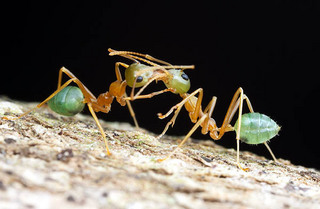
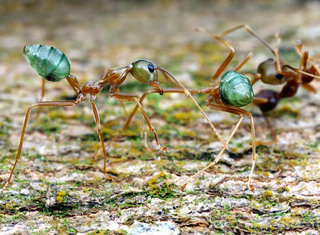
© Alex Wild, myrmecos.net, 2004
· 1
Oecophylla smaragdina |
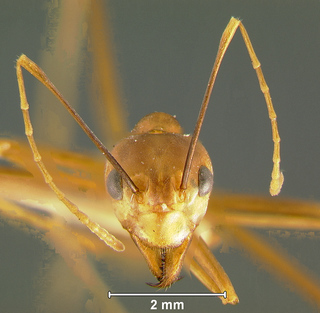
© Copyright Gary Alpert, 2005-2008
· 0
Oecophylla smaragdina, worker, head |
|
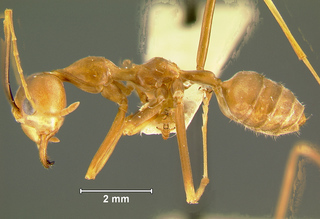
© Copyright Gary Alpert, 2005-2008
· 0
Oecophylla smaragdina, worker, side |
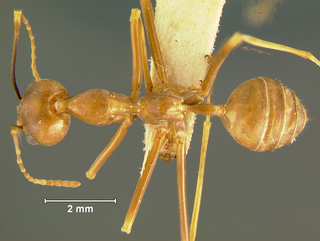
© Copyright Gary Alpert, 2005-2008
· 0
Oecophylla smaragdina, worker, top |
|
Overview | |
The brood of this species is eaten as a delicacy by the people of northern Luzon.
|
|
|
Names | |
Abu-os in Ilokano dialect
Tigasaw in Tagalog dialect
|
|
|
Geographic distribution | |
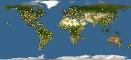
Widespread throughout the Philippines.
|
|
|
Natural history | |
This large, aggressive formicine ant builds arboreal nests. They use their larvae as living spindles to weave silk to connect the leaves. They form very large colonies, often covering several adjacent trees.
|
|
|
How to encounter | |
Look for large, yellowish to greenish guard ants on the trunks of trees. Overhead, you'll find the leaf nests in the foliage.
|
|
|
References | |
Holldobler, B. and E.O. Wilson 1990. The Ants. Belknap Press of the Harvard University Press, Cambridge, Mass. 732 pp.
|
|
| Supported by | |
|
Following modified from Australian Faunal Directory
|
Top | See original
| &pull 20q v5.145 20180528: Error 301 Moved Permanently http://biodiversity.org.au/afd/taxa/f5f0ee9f-a044-4092-920f-575f3da02fe8 |
Updated: 2024-04-24 06:20:11 gmt
|