|
|
Overview | |
Click here for Stonefly checklist in the Great Smoky Mountains.
Plecoptera (stoneflies) are a small order of insects of about 2000 species worldwide,
with their long but fragmented fossil record dating back to the early Permian. The
living suborders, Arctoperlaria and Antarctoperlaria, easily contain the earliest
fossils. The more modern fossils are easily indentifiable from Miocene (38 - 54 MYA)
fossils. -- (University of Texas)
|
|
|
Identification |
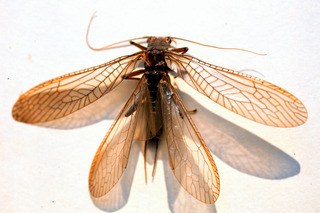
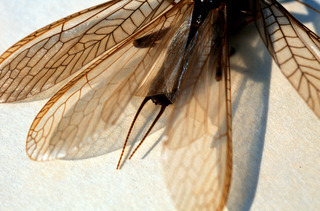
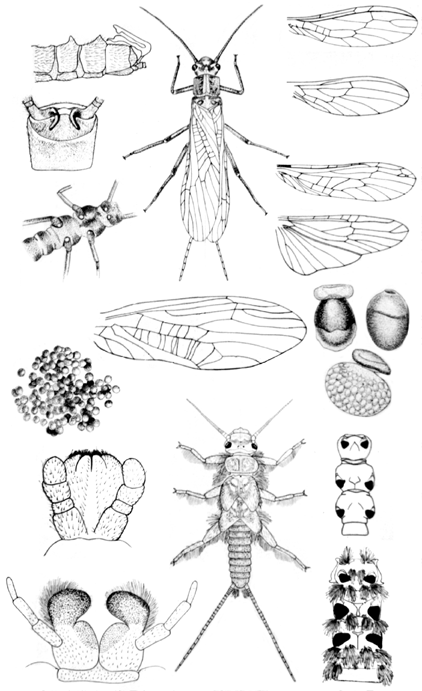
Stoneflies can be easily recognized by a few simple characters. They have three segmented
tarsi but their hind legs are not modified for jumping to the extent of Orthoptera (crickets
and grasshoppers). Their filiform antennae are at least half the length of the body. The
cerci are generally long as well, especially in the aquatic nymphs. The wings are almost
always present but are sometimes very short. They are folded horizontally back over the body.
These characters help distinguish them from Dermaptera and Embioptera which they superfically
resemble and to which they are probably closely related. The immatures are variously called
nymphs or naiads, but are most frequently referred to as nymphs. All nymphs are aquatic, and
resemble the adults in many respects. They also have three-segmented tarsi. The nymphs always
have long cerci and never a third central tail or median caudal filament. Gills, if they have
them, can occur on various parts of the thorax and abdomen and are composed only of filiments,
not plates.-- (University of Texas).
- Immatures
- Antennae long, filiform
- Body flattened, legs widely separated
- Tracheal gills present as "tufts" behind the head, at base of legs, or around the anus
- Each segment of thorax is covered by a large dorsal sclerite
- Cerci long, multi-segmented
- Adults
- Antennae long, filiform
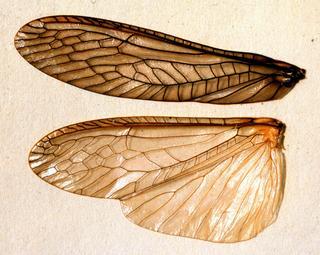
- Front wings long and narrow; M-Cu crossveins form distinctive boxes near center of front wing
- Hind wings shorter than front wings; basal area of hind wing enlarged and pleated
- Cerci long, multi-segmented-- (N.C. State University Entomology Dept.)
|
|
|
Phylogeny |
| Taxonomic Category
| Scientific Name
| Common Name
|
| Phylum
| Arthropoda
| Arthropods
|
| Class
| Insecta
| Insects
|
| Order
| Plecoptera
| Stonefly
|
The name Plecoptera, refering to the pleated hind wings which fold under the front wings
when the insect is at rest, is derived from the Greek "pleco" meaning folded and "ptera"
meaning wing. -- (N.C.
State University Entomology Dept.)
Suborder HOLOGNATHA
- Capniidae - small winter stoneflies
- Leuctridae - rolled-winged stoneflies
- Nemouridae - spring stoneflies
- Peltoperlidae - roachlike stoneflies
- Pteronarcidae - giant stoneflies
- Taeniopterygidae - winter stoneflies
|
Suborder SYSTELLOGNATHA
- Chloroperlidae - green stoneflies
- Isoperlidae - green-winged stoneflies
- Perlidae - common stoneflies
- Perlodidae - perlodid stoneflies
|
|
|
|
Geographic distribution |
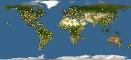
Common in and around fast-moving streams in temperate and boreal climates.
|
| North America
| Worldwide
|
| Number of Families
| 10
| 15
|
| Number of Species
| 465
| 2000
|
|
|
|
Natural history |
Stoneflies probably represent an evolutionary "dead end" that diverged well over 300
million years ago and are regarded as the earliest group of Neoptera. Immature stoneflies
are aquatic nymphs (naiads) that usually live under stones in fast-moving, well-aerated
water. Oxygen diffuses through the exoskeleton or into tracheal gills located on the thorax,
behind the head, or around the anus. Most species are herbivorous, feeding on algae and
other submerged vegetation, but two families (Perlidae and Chloroperlidae) are predators
of mayfly nymphs (Ephemeroptera) and other small aquatic insects. Adult stoneflies emerge
from their streams and can generally be found on the banks next to their previous habitat.
They are not active fliers and usually remain near the ground where they feed on algae or
lichens. In many species, the adults are short-lived and do not have functional mouthparts.
Stoneflies are most abundant in cool, temperate climates. --
(University of Texas)
Economic Importance:
Stoneflies require cool, well-oxygenated water for their nymphal development and are
therefore very susceptible to human abuse of water courses. Farm drainage, land
clearing, impoundment of water courses all of which cause changes in temperature and
substrate content can eliminate stoneflies from a habitat. --
(University of Texas).
Because of stoneflies' impact susceptibility, they are used by ecologists as indicators
of water purity. Stoneflies are also an important source of food for game fish (e.g., trout
and bass) in cold mountain streams.--
(N.C. State University Entomology Dept.)
|
|
|
How to encounter | |
With a few exceptions in the southern hemisphere living on damp soil, stonefly nymphs
dwell in aquatic habitats. The preferred habitat is rocky streams with at least a
noticeable current. Some species can live in damp sandy areas. Although we know
much less about lakes as habitats than rivers and streams, lakes can provide suitable
habitat in the north and at high latitudes.The usual habitat in running water contains
rocky, stony, or gravel substrata with more diversity in cooler, swifter water. Some
studies have shown a correlation between certain species and certain habitats. For
instance, Perlidae and Perlodidae are usually encountered under large stones, while
Chloroperlidae tend to occur in gravel and Pteronarcyidae are frequently found in leaf
packs.-- (University of Texas).
|
|
|
Links to other sites | |
|
|
|
Acknowledgements |
This page written by Michael Howell, Ecology major at the University of Georgia, Athens.
Thanks to Sabina Gupta, Denise Lim, and Dr. John Pickering for technical and web support in developing this page.
1. http://www.cals.ncsu.edu/course/ent425/compendium/stonef~1.html
2. http://www.sbs.utexas.edu/jcabbott/courses/bio321web/labs/plecoptera/Plecoptera.pdf
|
|
| Supported by | |
|
Following modified from University of Guelph
|
Top | See original
| &pull 20q v5.145 20180528: Error 301 Moved Permanently http://www.uoguelph.ca/debu/STEVEweb/html/Plecoptera.htm |
|
Following served from AEGA |
Top | See original context
ERROR -- Need to remove recursive link: http://www.discoverlife.org/nh/id/lucid/Insect_orders/html/Plecoptera.html Lucid via Discover Life
|
Following modified from Mississippi College
|
Top | See original
| &pull 20q v5.145 20180528: Error 301 Moved Permanently http://www.mc.edu/campus/users/stark/american.html |
|
Following modified from New York State Departement of Environmental Conservation
|
Top | See original
| &pull 20q v5.145 20180528: Error 301 Moved Permanently http://www.dec.ny.gov/animals/7450.html |
|
Following modified from Soil and Water Conservation Society of Metro Halifax
|
Top | See original
|
Disclaimer
& Copyright Notices; Optimized for the MS Internet Explorer
(Stonefly)
Soil & Water Conservation Society of Metro Halifax (
SWCSMH
)
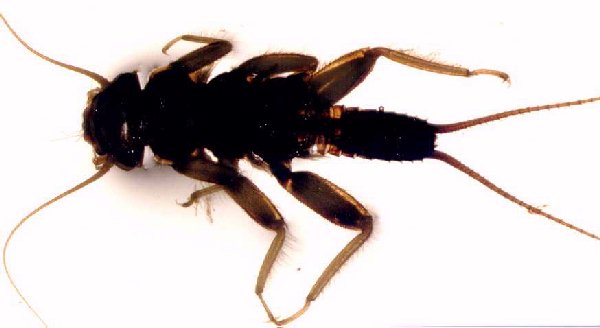
View: dorsal
Updated: October 09, 2013

Contents:
Linnean system of hierarchical classification
(
Williams & Feltmate, 1992
):
-
Superphylum Arthropoda
-
(jointed-legged metazoan animals [Gr,
arthron
= joint;
pous
= foot])
-
Phylum Entoma
-
Subphylum Uniramia
-
(L,
unus
= one;
ramus
= branch, referring to the unbranched nature of the appendages)
-
Superclass Hexapoda
-
(Gr,
hex
= six,
pous
= foot)
-
Class Insecta
-
(L,
insectum
meaning cut into sections)
-
Subclass Ptilota
-
Infraclass Neopterygota
Introduction
The Plecoptera (stoneflies), all of which are aquatic as nymphs, are considered to be the most primitive order of living Neoptera. Plecopterans number about 1718 species in 239 genera belonging to 15 families. Nymphs feed on fresh or decayed vegetable matter, but may be carnivorous in later instars.
The order Plecoptera belongs to the infraclass Neoptera because stoneflies' wings fold over their backs at rest. Wings develop in external wingpads, a characteristic that places Plecoptera in the division Exopterygota. North American stoneflies are generally divided into two groups, Euholognatha and Systellognatha, based on major differences in mouthpart morphology and, hence, feeding biology.
The taxonomy of this order, like that of the Ephemeroptera, is poorly known because the larvae of many species have not been associated with adults.
Modern plecopterans are thought to have been derived from the Protoperlaria of the Permian (360-286 million years B.P.) and the fossil record is quite respectable with more than 30 species described from the different strata of the Permian to the middle Tertiary.
Life History
The stoneflies are terrestrial as adults, but in the nymphal stages they are strictly aquatic, and most are restricted to flowing waters of relatively high oxygen concentrations. Fertile eggs, laid over or in the water, requite two to three weeks for hatching in many species, and several months among some larger forms. The nymphal instars, from 10 to over 30 moltings, occur in one to three years. Adults live from 1 to 4 weeks. Most adults are winged, although a few species are wingless (apterous) or have short wings (brachypterous). None fly well and this has prevented them from crossing even small geographical barriers.
Thus, like the mayflies, stoneflies are useful tools in studies of historical biogeography.
Temperate species that overwinter as nymphs often do not stop growing even in water temperatures close to 0°C. It seems that it is warm water temperatures rather than cold ones that punctuate stonefly life cycles. The ability to spend the summer in diapause enables some species to live in
temporary streams
.
Feeding
Generally, stonefly nymphs are either shredders or predators. Some groups that are predaceous as late instars have been reported to be herbivorous or detritivorous in early instars, while late instars of large detritivores may consume some prey. Predators are engulfers, that is, they swallow their prey whole or bite off and swallow parts of prey. They are active search or pursuit predators, using their long filamentous antennae to locate prey using tactile, wave disturbance, and chemical cues. Many species are opportunistic feeders, consuming prey in proportion to their relative abundance. Other species are selective for prey species or sizes. In some families adults feed, and in others they do not.
Habitat and Ecological preference
Plecopteran nymphs are restricted to cool, clean streams with high dissolved oxygen content. some species, however, may be found along the wave-swept shores of large oligotrophic lakes. When subjected to low dissolved oxygen concentration, the nymphs of many species exhibit a characteristic "push-up" behaviour that increases the rate of movement past the gills. The gills are variously placed among species on the neck, thorax and abdomen. However, some species have no gills and respiration in these is assumed to be across the cuticle surface.
The high water quality requirements of the nymphs bars all but a very few species from habitats subject to low oxygen levels, siltation, high temperatures and organic enrichment, and this has led to their effective use as biological indicators of environmental degradation.
Field surveys clearly show that the nymphs of many species are associated with particular sections of a stream bed or lake shore. The specific microhabitat occupied depends on a variety of environmental factors such as the nature of the substratum (particle size and configuration), current regime, presence of other organisms, and local variations in water chemistry and temperature. Habitat preference often changes as the nymphs develop and with season. Prior to emergence, final instar nymphs tend to migrate towards the bank where they crawl out of the water to shed their skins.
Most stoneflies are classified as clingers or sprawlers, as they are closely associated with the substrate or leaf litter. A few species have been reported from the hyporheic zone.
Some physiological and ecological tolerances and requirements
(
Mackie
, 2001)
|
Species |
General habitat |
Feeding |
pH |
Oxygen % |
|
Acroneuria lycorias
|
rocks, streams |
predator of insects |
<7 - >7 |
approx. 100 |
|
Allocapnia
spp. |
rocks, streams |
shredder |
>7 |
approx. 100 |
|
Amphinemura delosa
|
gravel, rocks, streams |
gatherer, shredder |
<7 - 7 |
100 |
|
Isoperla bilineata
|
plants, rocks, streams |
predator of insects, gatherer |
>7 |
100 |
|
Isoperla clio
|
plants, streams |
predator of insects |
>7 |
100 |
|
Isoperla fulva
|
plants, rocks, streams |
predator of insects, scraper, gatherer |
≥7 |
50-100 |
|
Nemoura trispinosa
|
plants, rocks, streams |
shredder |
<7 - >7 |
100 |
|
Peltoperla maria
|
leaf litter, streams |
shredder |
≥7 |
approx. 100 |
|
Perlesta placida
|
rocks, leaves, streams |
predator of insects, gatherer |
>7 |
approx. 100 |
|
Pteronarcys
spp. |
rocks, logs, leaves, streams |
predator, scraper, shredder |
≥7 |
approx. 100 |
|
Taeniopteryx maura
|
rocks, logs, leaves, streams |
gatherer, shredder |
<7 - >7 |
approx. 100 |
References and web URLs:
-
Hutchinson, G.E.
1993. A Treatise on Limnology. Vol. IV, The Zoobenthos. Ed. Y.H. Edmondson. John Wiley & Sons, Inc. Xx, 944pp.
-
Mackie, G.L. 2001. Applied Aquatic Ecosystem Concepts. Kendall/Hunt Publishing Company. xxv, 744 pp. ISBN 0-7872-7490-9
-
Narf, R. 1997. Midges, bugs, whirligigs and others: The distribution of insects in Lake "U-Name-It". Lakeline. N. Am. Lake Manage. Soc. 16-17, 57-62.
-
Peckarsky, B.L., P.R. Fraissinet, M.A. Penton, and D.J. Conklin, Jr. 1990. Freshwater Macroinvertebrates of Northeastern North America. Cornell Univ. Press. xii, 442pp.
-
Wetzel, R.G.
1983. Limnology. 2nd ed. Saunders College Publishing. Xii, 767pp, R81, I10.
-
Williams, D.D., and Feltmate, B.W. 1992. Aquatic Insects. CAB International. ISBN: 0-85198-782-6. xiii, 358p.

We salute the
Chebucto Community Net
(CCN) of
Halifax
,
Nova Scotia
,
Canada
for hosting our web site, and we applaud its volunteers for their devotion in making `CCN' the best community net in the world
|
Updated: 2024-04-23 09:46:10 gmt
|