|
80x5 -
240x3 -
240x4 -
320x1 -
320x2 -
320x3 -
640x1 -
640x2
Set display option above.
Click on
images to enlarge. |
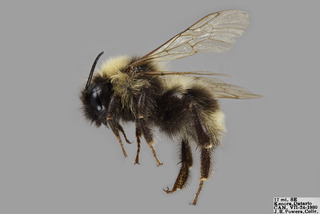
© Copyright Laurence Packer 2014
· 7
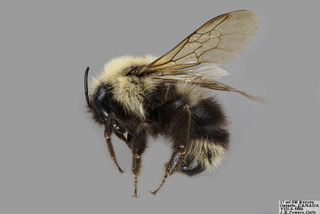
Bombus fernaldae MALE f |
© Copyright source/photographer
· 5
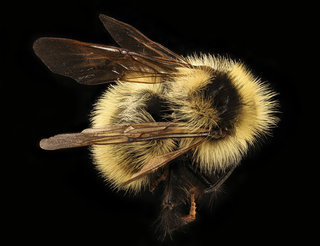
Bombus fernaldae, m, back, Centre Co., PA |
|
© Copyright source/photographer
· 5
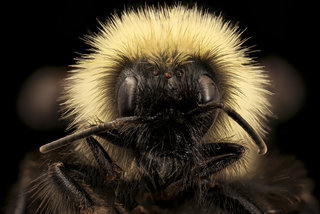
Bombus fernaldae, m, face, Centre Co., PA |
© Copyright source/photographer
· 5
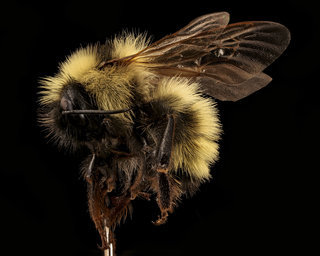
Bombus fernaldae, m, left side, Centre Co., PA |
|
Barcode of Life Data Systems · 1
Bombus fernaldae, Barcode of Life Data Systems |
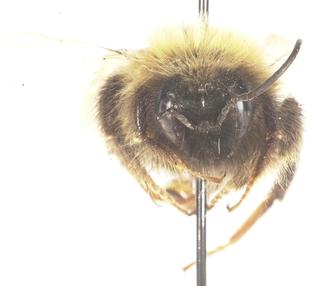
© Photographer/source
male front
UGCA196032_01
|
|
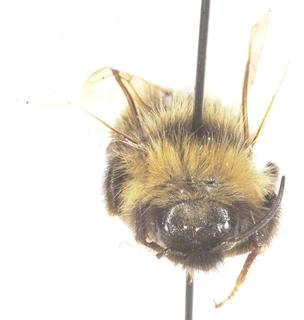
© Photographer/source
male front top
UGCA196032_02
|
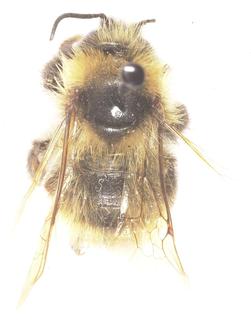
© Photographer/source
male top
UGCA196032_03
|
|
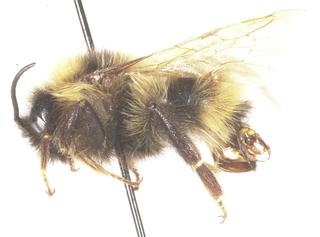
© Photographer/source
male side
UGCA196032_04
|
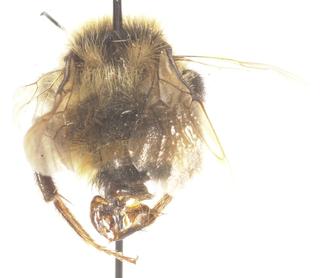
© Photographer/source
male rear
UGCA196032_05
|
|
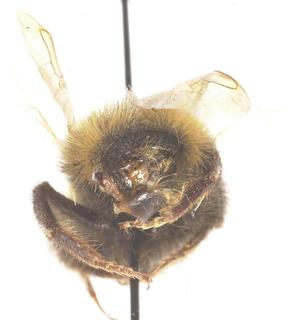
© Photographer/source
male rear tip
UGCA196032_06
|
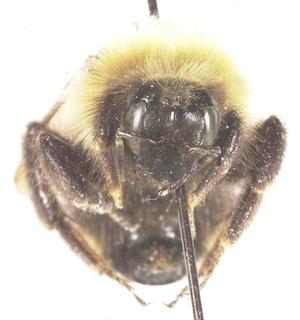
© Photographer/source
female front
UGCA196033_01
|
|
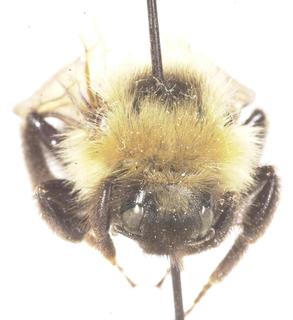
© Photographer/source
female front top
UGCA196033_02
|
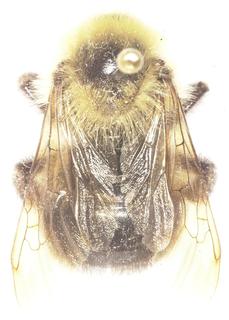
© Photographer/source
female top
UGCA196033_03
|
|
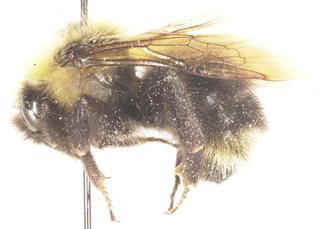
© Photographer/source
female side
UGCA196033_04
|
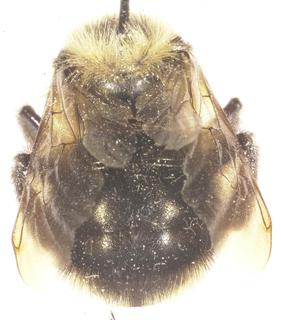
© Photographer/source
female rear
UGCA196033_05
|
|
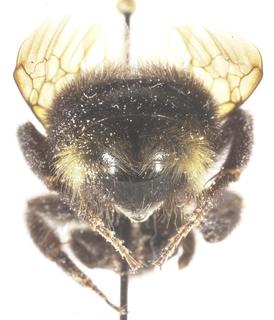
© Photographer/source
female rear tip
UGCA196033_06
|
|
Overview |
Reprinted with permission from: Mitchell, T.B. 1962 Bees of the Eastern United States. North Carolina Agricultural Experiment Station Technical Bulletin No. 152.
FEMALE—Length 14.5-17 mm., breadth of abdomen 7-8.5 mm.; black, tibial spurs reddish-piceous; wings rather uniformly, lightly infuscated, veins brownish to piceous; pubescence of face and cheeks black, vertex with copious and elongate, yellow pubescence, with a few intermixed yellowish hairs just above antennae; thorax with long and copious, largely yellowish pubescence, but scutum with a median posterior patch of fuscous pubescence; pleura beneath and legs largely dark pubescent, but posterior fringe of front femora pale in part; pubescence of abdominal terga erect and copious, intermixed yellowish and fuscous on basal tergum, largely fuscous on terga 2 and 3, with some yellowish hairs along apical margin, and laterally also on 3, tergum 4 yellow pubescent, 5 black pubescent, 6 with only very short and inspicuous, appressed pubescence; clypeus shining, punctures fine, rather deep and distinct along lateral and upper margins, becoming very minute and sparse apically; labrum slightly excavated medially, the basal margin slightly produced on each side, apical margin rounded, rather strongly depressed; apex of mandible entire, outer face smooth and shining, punctures exceedingly minute and indefinite; malar space smooth and shining, length fully equal to basal width of mandible, about one-fourth length of eye; lateral ocelli subequally distant from eyes and each other, somewhat more widely removed from margin of vertex; punctures of face and of vertex medially fine and close, vertex becoming more shining and more minutely and sparsely punctate laterally, a shining area adjacent to each lateral ocellus nearly impunctate; flagellum fully twice the length of the scape, its basal segment very slightly longer than segment 3, and 3 slightly longer than 2; scutum with a median, shining, impunctate space, punctures otherwise rather fine and close over most of thorax; sternum 6 elongate, produced beyond apex of the tergum, its tip somewhat down-curved, lateral margins very slightly elevated medially, the narrower apex densely, pale, short pubescent.
MALE—Length 13-15 mm., breadth of abdomen 6-7 mm; black, tarsal segments becoming brownish-testaceous apically, mid and hind spurs brownish-piceous; wings lightly but quite uniformly infuscated, veins testaceous to piceous; pubescence of face and cheeks• entirely black, quite long and copious, vertex with elongate, copious, yellowish pubescence; thorax with long, copious, largely yellow pubescence but posterior half of scutum with copious, erect, black pubescence, that on venter fuscous in part; legs with intermixed light and dark hairs, the posterior fringes of femora and basitarsi largely pale; abdominal terga 1 and 4 with elongate, yellowish pubescence, 2 3, 5, and 6 with largely black pubescence, that on 7, and on 6 laterally, yellowish; clypeus very finely and closely punctate, rather dull; labrum shining, punctures minute and to some degree separated, apical margin only slightly depressed, broadly subtruncate, with a transverse, median line of erect black hairs separating the lower and upper surfaces; mandibles small but quite distinctly bidentate at apex, with a rather prominant fringe of elongate pale hairs below; malar space smooth and shining, with only exceedingly minute, well separated punctures, length equal to basal width of mandible; eye about four and one-half times longer; lateral ocelli slightly nearer eyes than to margin of vertex, subequally distant from eyes and each other; segments 1 and 3 of flagellum about equal in length, somewhat longer than segment 2 which is about as broad as long; sterna 7 and 8 and genital armature as shown (fig. 134).
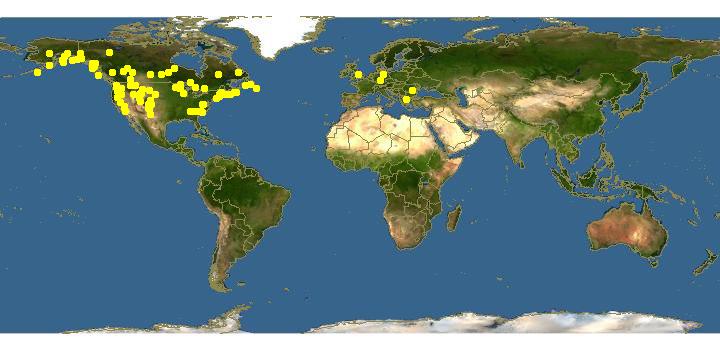
DISTRIBUTION — Widespread in Canada and the United States, from Alaska to California in the West, New Brunswick to North Carolina in the East, June to September.
FLOWER RECORDS—Potentilla, Rubus and Trifolium.
HOST—Plath (1934) suggests the possibility that Bombus perplexus is the host of fernaldae, but positive evidence is lacking.
|
|
|
Identification | |
Female - The last sternite elongated beyond tip of tergum, this slender projection down-curved Fernald cuckoo bumble bee Status: Uncommon Select food plant genera:
Aster, Senecio, Potentilla, Trifolium,
Chamaebatia, Cirsium Tongue Length: Short Hosts:
B. rufocinctus Distribution: Pacific coast east to New England Can be confused with
B. insularis Face black, top of head yellow or
cream, T1 often black, yellow in the
east, T2 black, T3 black or yellow, T4
yellow or cream, T5 black. Hind tibia with outer surface convex
and densely hairy. Hair of the face
black. T6 curled very strongly under
the abdomen and pointing anteriorly,
S6 ending distally with a shiny
triangular spine, the lateral keels
small. Hair long and uneven.
Extracted from: Laverty T.M., & Harder L.D., (1988). The Bumble Bees of Eastern Canada. Can. Ent. 120: 965-987.
Description. Body size of female small, male small to medium. Head round, malar space shorter than broad in female, about square in male. Tongue short. In females, tip of the abdomen sharply recurved. Colour as in Figure 26. In some females T3 partially or com- pletely white or yellow. In some males, interalar band indistinct around wing bases; T7
yellow in few specimens.
|
|
|
Names | |
|
|
| Supported by | |
Updated: 2024-05-05 01:51:47 gmt
|