D I S C O V E R    L I F E   
Bee Hunt! Odonata Lepidoptera 
  HomeAll Living ThingsIDnature guidesGlobal mapperAlbumsLabelsSearch
  AboutResearchEducationProceedingsPolistes FoundationPartnersLinksHelp

Juniperus flaccida Schltdl.

Drooping juniper

Links


Names
Scientific source:
      Integrated Taxonomic Information System


Following modified from The Gymnosperm Database
   
Top | See original

Gymnosperm Database
Link to jump to start of content Home Topics Bookstore Links Site Map Contact Us
search Google
the whole Web
conifers.org

[Search hints]

photo

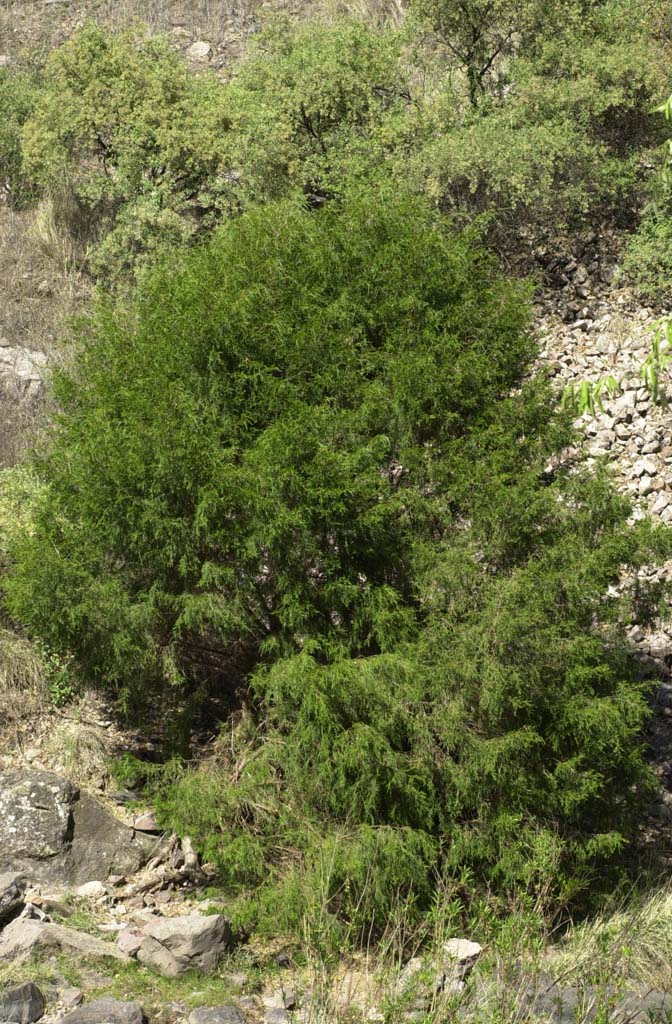
Tree of Juniperus flaccida var. poblana , collected along the toll road ca. 130 km N of Oaxaca [R. Van Pelt, 2005.02.08].

photo

Scale foliage and pollen cones from the tree shown above [C.J. Earle, 2005.02.08].

photo

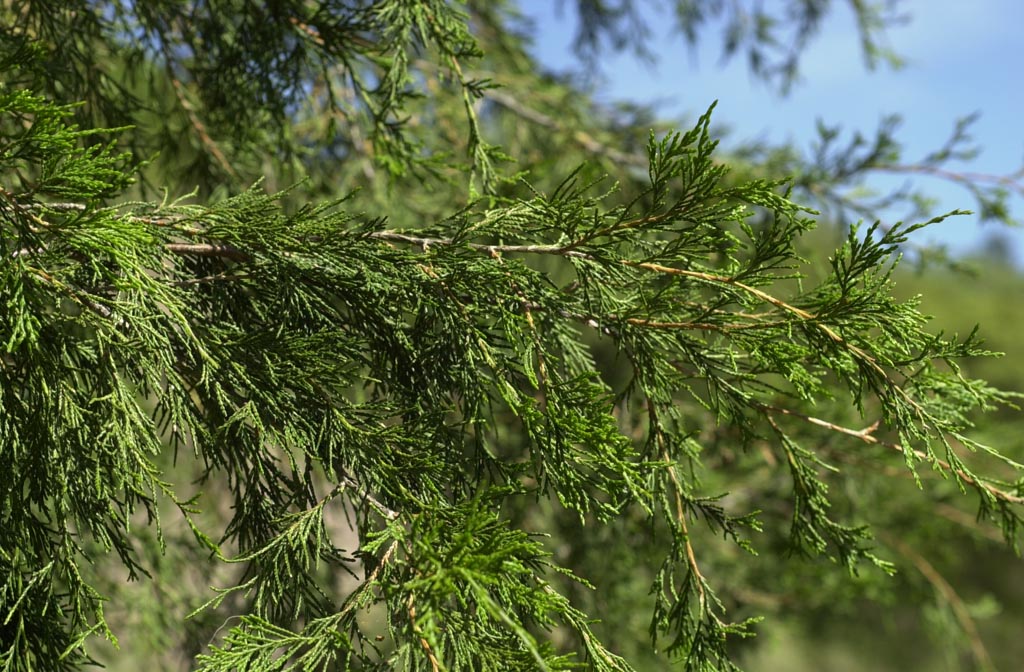
Branchlet from the tree shown above [C.J. Earle, 2005.02.08].

photo

Bark of the tree shown above, about 50 cm dbh [C.J. Earle, 2005.02.08].

photo

Sapling growing near the tree shown above. It is about 60 cm tall, has been heavily browsed, and retains acicular foliage [R. Van Pelt, 2005.02.08].

photo

Woodland of deciduous oak ( Quercus sp.) and J. flaccida var. poblana along the toll road about 50 km N of Oaxaca [R. Van Pelt, 2005.02.11].

photo

Cones on a tree in Jalisco [Mauricio Mantilla Blandon, 2006].

map

Distribution map ( USGS 1999 ).

photo

WP181, J flaccida 8m tall [C.J. Earle, 2007.02.16].

photo

WP179 J flaccida N-facing slope [C.J. Earle, 2007.02.16].


Valid HTML 4.01 Transitional

Juniperus flaccida

Schlechtendal 1838

Common names

Drooping juniper, drooping cedar ( Peattie 1950 ), cedro, cedro liso, cipres, enebro, sabino, tlascal, tascate, Mexican drooping juniper ( Zanoni and Adams 1979 ), weeping juniper ( Adams 2004 ).

Taxonomic notes

Three varieties:

  • Juniperus flaccida Schltdl. var. flaccida , Linnaea 12: 495 (1838).
  • Juniperus flaccida Schltdl. var. martinezii (Perez de la Rosa) Silba, Phytologia 58: 367 (1985).
  • Juniperus flaccida var. poblana Martínez, Anales Inst. Biol. Univ. Nac. México 17:31 (1946).

Synonymy for Juniperus flaccida var. flaccida ( Adams 2004 ):

  • J. gracilis Endl., Syn. Conif.: 31 (1847).
  • J. gigantea Roezl in part
  • J. flaccida var. gigantea (Roezl) Gaussen
  • J. foetida flaccida (Schlecht.) Spach
  • Sabina flaccida (Schlecht.) Antoine, Cupress.-Gatt.: 37 (1857).
  • S. flaccida (Schlecht.) A. A. Heller
  • S. flaccida (Schlecht.) I.M. Lewis

Synonymy for Juniperus flaccida var. martinezii ( Adams 2004 ):

  • Juniperus martinezii Perez de la Rosa, Phytologia 57: 81 (1985).

Synonymy for Juniperus flaccida var. poblana ( Adams 2004 ):

  • Cupressus thurifera Kunth in Humboldt et al., Nova Gen. Sp. Pl. 2(5): 3 (1817).
  • Cupressus thurifera Schltdl., Linnaea 12: 493 (1838), non Kunth (1817).
  • Chamaecyparis thurifera (Kunth) Endl., Syn. Conif. 62 (1847).

Description

Dioecious trees or shrubs up to 12 m tall, trunks forking 1-2 m above base, crown globose. Bark cinnamon to red-brown or gray to red-brown, exfoliating in broad interlaced fibrous strips. Bark on branchlets (5-10 mm diameter) smooth, that on larger branches exfoliating in wide strips or plates. Branches drooping; branchlets somewhat pendulous, 3-4-sided in cross section, ca. 2/3 or less as wide as length of scalelike leaves. Leaves green, abaxial gland variable, elongate, conspicuous, exudate absent, margins appearing entire at 20× but with irregular teeth at 40×; decurrent leaves 4-6 mm, not glaucous adaxially; scale leaves 1.5-2 mm, overlapping by 1/4-1/5 their length, apex rounded to acuminate, spreading. Seed cones maturing in 1 year, of similar size, with straight to curved peduncles, globose, 5-20 mm, tan-brown to brownish purple when mature, glaucous, obscurely woody, with 1-13 seeds. Seeds 5-6 mm long ( Zanoni and Adams 1979 , Adams 1993 , Adams 2004 ).

Adams (2004) provides the following key to the varieties:

1a.

Seed cones 5 - 9 mm diam., with 1 - 2 (3) seeds, foliage scarcely weeping


var.  martinezii

1b.

Seed cones 9 - 20 mm diam., with (4-) 6-10 (-13) seeds, foliage weeping


2

2a.

Scale leaves on ultimate twigs obtuse, scale leaf tips appressed, mature seed cones usually smooth (or with horn-like protuberances from the enlarged cone-scale tips)


var.  flaccida

2b.

Scale leaves on ultimate twigs acute and sharp, scale leaf tips divergent, mature seed cones usually showing suture lines from the fusion of cone-scales


var.  poblana

Var. flaccida is a tree up to 12 m tall, with the trunk usually forking at 1-2 m. Bark is cinnamon red-brown or gray red-brown, exfoliating in broad interlaced fibrous strips. Branches spread to form a globular crown. Branchlets are drooping, flaccid. Leaves include both decurrent and scale types, the scale leaves often appearing somewhat decurrent, 1.5-2 mm long, opposite, narrowly ovate, acuminate. Both decurrent and scale-leaf margins appear entire under 20× magnification, but have irregular teeth at 40×. Seed cones are (4-)6-10(-13) seeded, tan-brown to brown-purple, glaucous, 9-20 mm in diameter. Seeds are 5-6 mm long. Pollen is shed late winter-early spring ( Adams 2004 ).

Var. martinezii is a shrub (rarely a tree) 4-8 m tall, with a round to broadly conical crown. Bark is grey-brown, exfoliating in interlaced strips. Branches are grey, the terminal branchlets flaccid or pendulous. Leaves are usually opposite and not imbricate, (1.5-)2(-2.5) mm long, 1.0(-1.5) mm wide, ovate to elongate-ovate, acuminate, mucronate, with a dorsal gland; the hyaline margin is barely dentate at 40× magnification.Seed cones are ovoid, (5-)6(-8) mm long by (5-)6(-9) mm wide, brownish, smooth, holding 1-2(-3) seeds, each 3-5 mm long × 3-4 mm wide. Pollen is shed in late spring ( Adams 2004 ).

Var. poblana is a tree up to 8 m tall, usually with a forked trunk and globose crown. Bark is brown, exfoliating in wide strips. Branches are erect, but flaccid at the tips, so that the tree retains a "drooping" character in comparison with other Mexican junipers. Both scale and decurrent leaves are conspicuous, the scale leaves on ultimate twigs with sharp, acute, divergent tips (appearing decurrent). Seed cones are glaucous, blue-brown, 9-12 mm in diameter; the mature cones usually show suture lines from fusion of the cone-scales, thus resembling a soccer ball. There are (4-)6-10(-13) seeds per cone. Pollen is shed in the spring ( Adams 2004 ).

Range

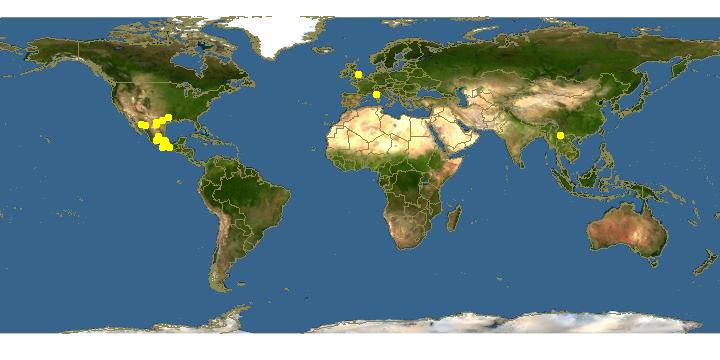
Mexico: Aguascalientes, Chihuahua, Coahuila, Distrito Federal, Durango, Guanajuato, Guerrero, Hidalgo, Jalisco, México, Michoacán, Morelos, Nuevo León, Oaxaca, Puebla, Queretaro, San Luis Potosí, Sonora, Tamaulipas, Veracruz, and Zacatecas; and USA: Texas ( Zanoni and Adams 1979 ).

Var. flaccida , the most common, occurs in Mexico: Chihuahua, Coahuila, Distrito Federal, Durango, Guanajuato, Guerrero, Hidalgo, Jalisco, México, Michoacán, Morelos, Nuevo León, Oaxaca, Puebla, Queretaro, San Luis Potosí, Sonora, Tamaulipas, and Zacatecas; and USA: Texas ( Zanoni and Adams 1979 ), where it grows in the Chisos Mtns. at 1830 to 2440 m ( Peattie 1950 ). See also Thompson et al. 1999 .

Var. martinezii is restricted to small, local populations in Mexico: Aguascalientes, Guanajuato, Jalisco, San Luis Potosí, and Veracruz (Adams et al. 1990).

Var. poblana occurs in southern Mexico. Zanoni and Adams (1979) map its occurrence at 1200-2300 m elevation in Jalisco, Hidalgo, México, Moreles, Distrito Federal, Puebla, Guerrero and Oaxaca, and infer its presence in intervening areas. It lives on dry, calcareous slopes, in pure stands or in mixed forests, at 1200-2300 m elevation. It is not nearly as common as its congeners in the western United States, but is usually abundant where it occurs.

Big tree

A tree with diameter 82 cm, height 17 m, and crown spread 11 m, is located in Big Bend National Park, Texas ( American Forests 1996 ). It is quite possible that larger specimens occur in Mexico, but I have no information on this.

Oldest

Dendrochronology

Ethnobotany

Observations

Remarks

Citations

Adams, R.P., J.A. Perez de la Rosa and M. Charzaro. 1990. The leaf oil of Juniperus martinezii Perez de la Rosa and taxonomic status. J. Essential Oil Res. 2:99-104. Available online at juniperus.org .

See also

Farjon (2005) provides a detailed account, with illustrations.

R.P. Adams' web site, juniperus.org .

Vascular Plant Image Gallery .

Home

Back | Juniperus | Cupressaceae | Site map | Contact us

Copyright

Edited by Christopher J. Earle

Page updated on 2009.07.04

URL: http://www.conifers.org/cu/ju/flaccida.htm

Back to top

Following modified from Plants Database, United States Department of Agriculture
   Top | See original

Link: Skip repetitive navigation links
USDA and NRCS Identifier NRCS Logo
USDA.gov Web Site PLANTS photo banner
PLANTS Home  about PLANTS  PLANTS Team  Partners of PLANTS  What  National Plant Data Center Web Site  Help using PLANTS  Contact PLANTS
 
 Search the PLANTS Web site
 Name Search

 State Search
 Advanced Search
 Search Help
PLANTS Topics
 
 Alternative Crops
 Characteristics
 Classification
 Culturally Significant
 Distribution Update
 Fact Sheets & Plant Guides
 Invasive and Noxious Weeds
 Links
 Plant Materials Publications
 Threatened & Endangered
 Wetland Indicator Status
 
PLANTS Image Gallery
 
 40,000+ Plant Images
 Submit Your Digital Images
 
Download PLANTS data
 
 Complete PLANTS Checklist
 State PLANTS Checklist
 Advanced Search Download
 Symbols for Unknown Plants
 NRCS State GSAT Lists
 NRCS State Plants Lists
 PLANTS Posters
 
Related tools
 
 Crop Nutrient Tool
 Ecological Site Information System
 PLANTS Identification Keys
 Plant Materials Web Site
 Other NRCS Tech
Resources
 VegSpec
 
 
You are here: Home / PLANTS Profile Printer-Friendly Printer-Friendly
PLANTS Profile
Alabama Alaska Arizona Arkansas California Colorado Connecticut Delaware District of Columbia Florida Georgia Hawaii Idaho Illinois Indiana Iowa Kansas Kentucky Louisiana Maine Maryland Massachusetts Michigan Minnesota Mississippi Missouri Montana Nebraska Nevada New Hampshire New Jersey New Mexico New York North Carolina North Dakota Ohio Oklahoma Oregon Pennsylvania Rhode Island South Carolina South Dakota Tennessee Utah Vermont Virginia Washington West Virginia Wisconsin Wyoming Puerto Rico Virgin Islands Alberta British Columbia Manitoba New Brunswick Labrador Newfoundland Nova Scotia Ontario Prince Edward Island Quebec Saskatchewan Yukon Northwest Territories Nunavut Greenland Saint Pierre and Miquelon


Juniperus flaccida Schltdl.
drooping juniper

       
Symbol:   JUFL  
Group:   Gymnosperm  
Family:   Cupressaceae  
Duration:   Perennial  
Growth Habit:   Tree  
Native Status:  
L48    N


Click on the image below to enlarge it and download a high-resolution JPEG file.
Photo of Juniperus flaccida Schltdl.
G.B. Sudworth. Provided by National Agricultural Library . Originally from US Forest Service . 1913. Usage Requirements .
 
More Information:
 

Images:
Juniperus flaccida Schltdl.

Click on a thumbnail to view an image, or see all the Juniperus thumbnails at the PLANTS Gallery
View a larger version of this image and Profile page for Juniperus flaccida Schltdl.
 

Synonyms:
Juniperus flaccida Schltdl.

  JUFLG Juniperus flaccida Schltdl. var. gigantea (Roezl) Gaussen
  JUGI Juniperus gigantea Roezl p.p.
  JUGR4 Juniperus gracilis Endl.
  SAFL16 Sabina flaccida (Schltdl.) Antoine
 

Distribution:
Juniperus flaccida Schltdl.

View Native Status
Distribution Map Legend

See U.S. county distributions (when available) by clicking on the map or the linked states below:

USA ( TX )
 

Related Taxa:
Juniperus flaccida Schltdl.

View 17 genera in Cupressaceae , 28 species in Juniperus
 

Classification:
Juniperus flaccida Schltdl.

Click on a scientific name below to expand it in the PLANTS Classification Report.
   
Kingdom Plantae – Plants
Subkingdom Tracheobionta – Vascular plants
Superdivision Spermatophyta – Seed plants
Division Coniferophyta – Conifers
Class Pinopsida
Order Pinales
Family Cupressaceae – Cypress family
Genus Juniperus L. – juniper
Species Juniperus flaccida Schltdl. – drooping juniper
 

More Accounts and Images:
Juniperus flaccida Schltdl.

View species account from USDA Forest Service Fire Effects Information System (FEIS).

View species account and distribution map from Flora of North America (FNA).

View taxonomic account from Integrated Taxonomic Information System (ITIS) for ITIS Taxonomic Serial Number 194842.

View species account and photographs from Lady Bird Johnson Wildflower Center Native Plant Information Network (NPIN).


Time Generated: 02/09/2010 12:57 PM MST  

 PLANTS Home | USDA.gov | NRCS | Site Map | Policies and Links
Accessibility Statement | Privacy Policy | Non-Discrimination Statement

Updated: 2010-02-09 20:01:16 gmt
Discover Life | Top
© Designed by The Polistes Corporation