| ||||||
Pheidole megacephala (Fabricius, 1793:161)Big-headed ant; Bigheaded ant; Brown House-Ant; Lion Ant |
|---|
| Links |
We parsed the following live from the Web into this page. Such content is managed by its original site and not cached on Discover Life. Please send feedback and corrections directly to the source. See original regarding copyrights and terms of use. |
|
80x5 -
240x3 -
240x4 -
320x1 -
320x2 -
320x3 -
640x1 -
640x2 Set display option above. Click on images to enlarge. | |
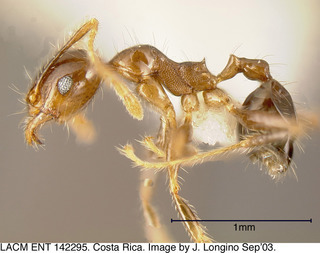
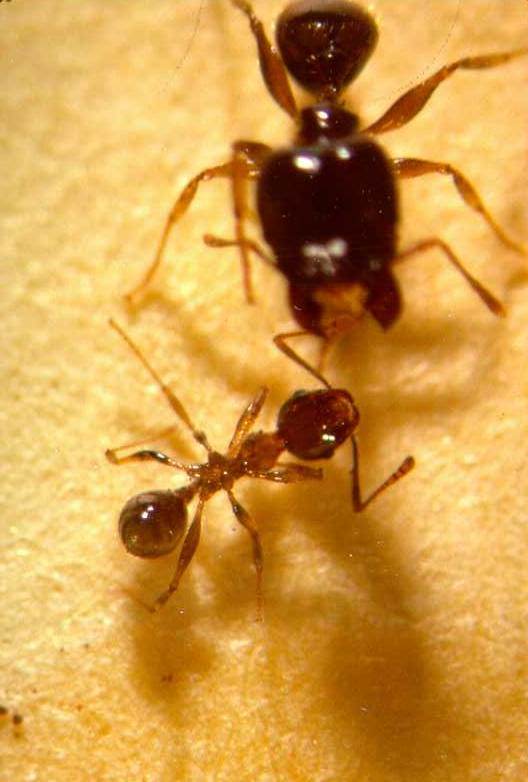
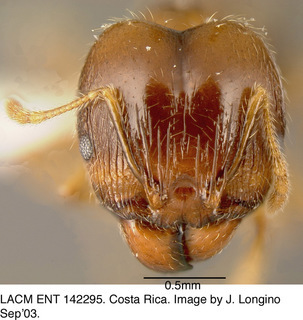
![]() © Jack Longino, Evergreen State College, 2004 Pheidole megacephala, worker major, head |
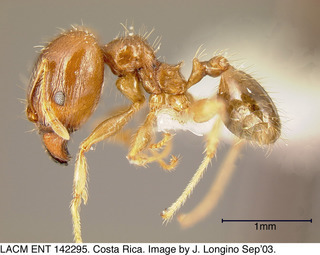
![]() © Jack Longino, Evergreen State College, 2004 Pheidole megacephala, worker major, side |
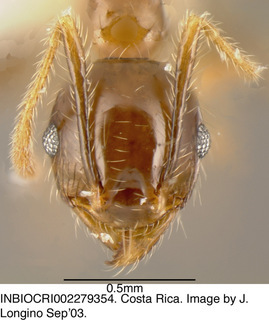
![]() © Jack Longino, Evergreen State College, 2004 Pheidole megacephala, worker minor, head |
![]() © Jack Longino, Evergreen State College, 2004 Pheidole megacephala, worker minor, side |
| Names | |
| |
| References | |
|
Eguchi, K. 2001. A taxonomic study on Asian Pheidole: new synonymy, rank changes, lectotype designations and redescriptions. Insecta Koreana 18: 1-35.
Eguchi, K. 2004. Taxonomic revision of two wide-ranging Asian ants, Pheidole fervens and P. indica (Insecta: Hymenoptera: Formicidae) and related species. Annalen des Naturhistorischen Museums in Wien 105B: 189-209. | |
| Following served from Hawaiian Ecosystems at Risk Project (HEAR) |

| Following modified from Evergreen State College |
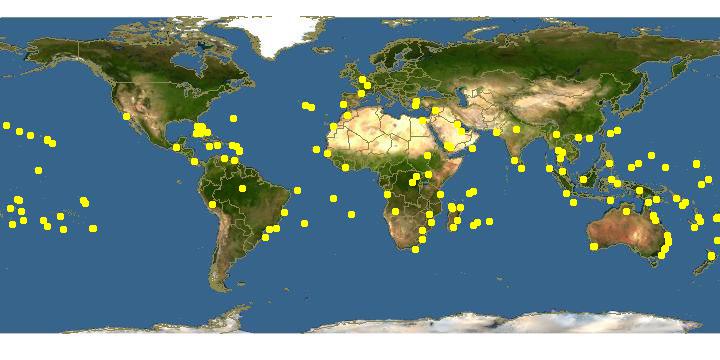
http://www.evergreen.edu/ants/genera/PHEIDOLE/SPECIES/megacephala/megacephala.html ---> http://academic.evergreen.edu/projects/ants/genera/PHEIDOLE/SPECIES/megacephala/megacephala.htmlPheidole megacephala (Fabricius 1793)Formicidae, Hymenoptera, Insecta, Arthropoda, Animalia Identification Minor worker: head length 0.59mm, head width 0.53mm, scape length 0.58mm, Webers length 0.72mm (n=1). Head rounded behind; promesonotum evenly arched, mesonotal suture very weak; propodeal spines small but distinct; face and pronotum smooth and shining, katepisternum and lateral propodeum feebly foveolate; postpetiole grossly swollen ; dorsal pilosity abundant, long, flexuous, some setae on mesosomal dorsum branched near apex, branches minute; color brown. Major worker: head length 1.22mm, head width 1.21mm, scape length 0.65mm (n=1). Face between frontal carinae with parallel longitudinal carinae, space between eyes and frontal carinae punctatorugose overlain with parallel longitudinal carinae, rest of face smooth and shiny; hypostomal margin nearly flat, with pair of very small, low tubercles, located about one third distance from midline to recessed teeth flanking mandibles (superficially looks like there are no hypostomal teeth); dorsal pilosity abundant; sparse subdecumbent setae projecting from sides of head in face view. Range A cosmopolitan tramp found in many tropical and subtropical regions, introduced in New World tropics. Natural History This species is an invasive pest ant in many parts of the world. Hoffman et al. (1999) documented an invasion of a rainforest patch in northern Australia. Although P. megacephala is usually associated with disturbed or depauperate sites, in this case it was able to invade a diverse tropical rainforest. In plots where P. megacephala was most abundant, native ants were almost completely extirpated. Abundance of other native invertebrates was reduced 42-85 percent in plots where P. megacephala occurred. P. megacephala is reported from Costa Rica in Kempf (1972), but we do not know the source of this report. Longino has worked in Costa Rica nearly every year since 1979, but did not collect P. megacephala from Costa Rica until 1996, when it was found infesting the Hotel Galilea. He had commonly used this hotel during the previous decade, so the P. megacephala were clearly a new arrival. Since then, he has noticed the species in various sidewalk borders and planters in San Jose, and in the Hotel Cacts on the opposite side of San Jose from the Hotel Galilea. Thus, the species appears well established in the San Jose core. Its distribution elsewhere in the country is unknown. Cover identified one collection of the species from La Selva Biological Station (collected by L. Tennant, March 1989, carton nest, underside of Dieffenbachia leaf), but no other collections have been made at La Selva, in spite of extensive inventory work at the site (Project ALAS). Pheidole megacephala is an exotic species with a potentially devasting impact on native invertebrate faunas, and its distribution and abundance should be closely monitored in Costa Rica. Literature Cited Hoffman, B. D., A. N. Andersen, G. J. E. Hill 1999. Impact of an introduced ant on native rain forest invertebrates: Pheidole megacephala in monsoonal Australia. Oecologia 120:595-604. Kempf, W. W. 1972. Catalogo abreviado das formigas da regiao Neotropical. Stud. Entomol. 15:3-344. Page authors: John T. Longino, The Evergreen State College, Olympia WA 98505 USA. longinoj@evergreen.edu Stefan Cover, Museum of Comparative Zoology, Harvard University, Cambridge MA 02138 USA. scover@oeb.harvard.edu Date of this version: 2 September 2003. Previous versions of this page: 8 December 1997 |
| Following modified from Pheidole megacephala on AntWeb |
Species: Pheidole megacephalaTaxonomic Hierarchy:Subfamily: Myrmicinae Genus: Pheidole
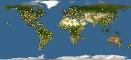
Distribution:All the main islands, and some Northwest Hawaiian Islands
Taxonomic History (provided by Barry Bolton, 2010)megacephala . Formica megacephala Fabricius, 1793: 361 (s.) no locality given. Latreille, 1802c: 232 (q.); Mayr, 1861: 70 (s.w.q.m.); Wheeler, G.C. & Wheeler, J. 1953b: 75 (l.). Combination in Pheidole : Roger, 1863b: 30. Senior synonym of trinodis : Roger, 1863b: 30; of edax : Dalla Torre, 1892: 90; Emery, 1892b: 160; of perniciosa : Emery, 1915j: 235; of pusilla (and its junior synonyms janus, laevigata Smith, laevigata Mayr): Wheeler, W.M. 1922a: 812; of suspiciosa : Donisthorpe, 1932c: 455; of testacea : Brown, 1981: 530; of agilis : Eguchi, 2008: 56. [ P. megalocephala Schulz, 1906: 155; unjustified emendation.] Current subspecies: nominal plus costauriensis, duplex, ilgi, impressifrons, melancholica, nkomoana, rotundata, scabrior, speculifrons, talpa . See also: Eguchi, 2001b: 77; Wilson, 2003: 549.
Taxonomic Treatment (provided by Plazi )Forel, A., 1912 : [[soldier]] [[worker]]. Takao. Smith, F., 1861 : , Smith, Proc. Linn. Soc. Supp. v. 112. 5. Mr. Wallace has sent a series of workers of this species collected from the nest. These contain, as it were, three modifications of the enormously large-headed individuals; all of these have heads similar in form, subquadrate, longitudinally striated anteriorly, and transversely so behind; these I should call varieties of the worker major; the worker minor has the head subovate in form, smooth, polished and shining; not striated behind, and very faintly so anteriorly. The links which would unite these two distinct forms of the working ants are wanting. I am therefore still of opinion that societies of ants generally possess two distinct sets of workers whose functions are totally different; this is known to be the case in slave-making communities, and also in the remarkable genus Eciton , of which only the workers are known. Santschi, F., 1914 : - Naivasha (station 14). Commensaux: Coleopteres (Paussus). Entom. Syst., vol. 2, p. 361 (1775). - Dalla Torre, Cat. Hym., vol. 7, Formicidae, p. 92 (1893). Afrique orientale anglaise: region cotiere: Shimoni (st. n° 9, nov. 1911), [[worker]], [[soldier]]; - riviere Ramisi (st. n° 3, nov. 1911), 9 [[worker]]; - Naivasha, dans le Rift Valley (alt. 1.900 m., st. n° 14, dec. 1911), [[worker]], [[soldier]] -Nairobi (1904), [[worker]]; - idem (1903), [[worker]], [[soldier]], [[queen]]; - Port-Florence, sur la baie de Kavirondo (st. n° 22, dec. 1911). Afrique orientale allemande: Tanga (st. n° 74, avril 1912), [[worker]]; - Kilimandjaro: Neu-Moschi (alt. 800 m., st. n° 72, avril 1912), [[worker]]. Espece cosmopolite sous les tropiques. Les nids de ce Pheidole etaient abondants sous les pierres plates d'un petit col de la route dc Naivasha a Nyere, au-dessus du vallon de Naivasha (alt. 1.600 m. env.). Quelques Paussus ont ete recueillis dans ces fourmilieres (st. n° 14, 16 dec. 1911). Dans la st. n° 22, Pheidole megacephala a ete recueilli dans les galeries d'une termitiere [Termes bellicosus Smeath] sur les bords du Victoria Nyanza. (Alluaud et Jeannel.) Forel, A., 1908 : [[ worker ]] Costa Rica (Biolley). Bernard, F., 1953 : En 1937, SANTSCHI en a separe comme espece la race punctulata MAYR et ses 3 varietes. Il reste neanmoins dans megacephala , espece cosmo-tropicale, onze sous-especes et 8 varietes, rien que pour l'Afrique. Le polymorphisme des soldats, tres net pour des formes classiques comme P. pallidula mediterraneenne , aurait du inciter les specialistes a la prudence. J'avoue ne- pas y voir tres clair dans le fouillis des races, et voici simplement les quelques formes du Nimba correspondant a des types extremes et bien tranches: . T91, Gouela. Prairie a 1.600 m. (LaMOTTE). Peu commune. Femelle (inedite). Types: une [[queen]] ailee et 5 [[queen]] desailees de la savane du Nimba. Cotypes: 2 [[queen]] ailees immatures de la crete du Mont To, a 1.600 m. Long.: 6,5 a 7,5 mm. Brunchocolat, luisantes sauf a la base du gastre. Thorax encore plus plat que chez megacephala Les 2 bandes du mesonotum en occupent plus de la moitie et s'etendent sur toute sa longueur (sur la moitie posterieure seulement chez megacephala et sa sbsp. pusilla ). Le second n oe ud du petiole est plus anguleux lateralement, entierement mat et convexe en-dessus (plus ou moins luisant et a 2 gibosites chez megacephala ). Pheidole de tres petite taille (soldat: moins de 4 mm., [[worker]]: 2 mm. au plus), Ces petites Fourmis, dont il y a une douzaine d'especes en Afrique, sont peu connues et rares dans les collections,, probablement parce qu'elles vivent surtout dans la paroi des termitieres ou dans les mousses des forets. Le Nimba en a donne 5 especes dont 2 inedites: Forel, A., 1893 : [[ worker ]] [[ soldier ]] et [[ queen ]]. (No. 49 a a 49 d). Cosmopolite dans les tropiques, (49). Apparently a rare species. (49 a). Wallilobo (leeward), Nov. 8 th; seashore. From passages at the root of a tree. Formicary could not be found. The ants are moderately active, and not very pugnacious. (49 b). Fitz-Hugh Estate (leeward), near sea-level. Dec. 12 th. A large community, with extensive passages about an old arrowroot-machine; the passages partly under stones, or by the sides of posts which supported the machine; partly in the ground near the surface. In places there were galleries, covered with a substance apparently formed of wood-fibre and earth. I could find no larvae, and no males nor females, though I dug deep. Probably this was a branch of the main nest, which may have been some distance away. The workers major were numerous, probably one-fourth of the whole. The place was quite near the seashore. (49 c). Petit Bordelle Estate; open land near the sea. Dec. 15 th. A very large community (eight or ten thousand, I should think), under turf on a rock; shore of a stream. The chambers were large, some of them four inches long and wide, but not high; and they were partly built up with walls of wood-fibre or some similar substance. The passages were numerous, and the whole formicarium occupied a space of about two square feet. The workers major are not numerous; about as one to twenty compared with the workers minor. Only one female could be found. The larvas were numerous. This ant walls in a large proportion of its works, both pas-. sages and chambers, with ' the wood-fibre substance mentioned above. It does not tunnel more than an inch or two below the surface of the ground, so far as I can discover. (44 d). Same locality and date as No. 49 c, but another nest; under a stone. Most of the space under the stone was occupied by a large chamber, about 6 x 4 in., but not high, around the outside of the stone; next the ground were other chambers, formed of the wood-fibre substance. Apparently this was only a part of the nest, with. ' branches under other stones. Only one female found. The species is common at Petit Bordelle, but I have not been able to find males. Forel, A. : [[ worker ]]. Fundnotiz: Mayotte und Anjou an (Comoren). Forel, A., 1907 : [[ worker ]] [[ queen ]] [[ male ]] [[ soldier ]]. Coetivy; Amirantes; Farquhar; He Desroches. Espece cosmopolite. Emery, C., 1893 : ? Canaria (4), Tenerife (M. Noualhier). Espece cosmopolite. Mayr, G., 1893 : Bagamoyo und Kihengo. Donisthorpe, H. S. J. K., 1949 : , Ent. Syst. " ii. p. 361 1793). 1 [[ worker ]]. Le Pouce Mt., Mauritius, November 2 nd, 1948 (Mamet). Emery, C., 1894 : - Mahe, Praslin, La Digue, Marie-Anne, Ile-Ronde. Parait etre la Fourmi la plus commune aux Sechelles; c'est une espece cosmopolite, mais qui offre des varietes locales assez marquees; la variete scabrior n'a ete rencontree jusqu'ici qu'a Madagascar. Emery, C., 1915 : Les soldats ont la tete considerablement retrecie en avant, en quoi ils different de pallidula et de picata ; le corselet est plus large que chez pallidula , notamment le pronotum; ce segment a des epaules plus ou moins marquees, qui ne se voient pas, ou sont rudimentaires chez pallidula . La tete est ordinairement luisante dans sa partie posterieure, rugueuse longitudinalement, pointillee et mate, sur le front, les parties laterales de l'epistome et les joues; la portion rugueuse s'etend sur les cotes, en arriere de l' oe il; a l'endroit ou s'appuie le scape, il y a une impression plus ou moins pointillee, mate. Le derriere de la tete a des points piligeres de grandeur variable; le fond du sillon median a generalement des strioles longitudinales, qui s'etendent; parfois plus ou moins sur le vertex et l'occiput. L'ouvriere est, en general, plus petite que pallidula par rapport au soldat. Elle a la tete plus etroite, surtout chez les individus de petite taille, plus arrondie en arriere et le bord posterieur n'est pas droit, en quoi elle differe de pallidula et de picata . On remarque, au moins chez les individus de petite taille, le bord releve du trou occipital, faisant saillie, quand on regarde la tete en dessus. Je n'ai pas etudie les caracteres des femelles et des males, je ne dispose pas d'un materiel suffisant pour le faire utilement. Je n'ai pas l'intention de donner une description complete des sous-especes et varietes de Ph. megacephala : pour cela je renvoie le lecteur aux auteurs´qui les ont publiees. Il me suffira d'avoir mis un peu d'ordre dans cet echeveau embrouille. Il y a, sans doute, beaucoup de choses obscures, particulierement dans la serie punctulata-rotundata et dans ce qui est confondu sous le nom de la forme cosmopolite « pusilla », dans son sens restreint. Dans cette derniere surtout, des mutations dues aux conditions d'existence (notamment dans l'Amerique meridionale) meriteraient une etude. Caracterisee par la longueur des epines de l'epinotum. Caracterisee par les strioles dursillon median de l'occiput qui sont plus nombreuses et envahissent souvent les parties lisses de la tete du [[ soldier ]]; les points des lobes occipitaux sont aussi plus forts. Ces deux varietes sont repandues a Madagascar et dans les iles voisines jusqu'aux Sechelles. Je veux essayer de donner une explication du cosmopolitisme, du, sans aucun doute, au commerce, de Ph. megacephala pusilla . Cette Fourmi est, je pense, originaire des iles de l'ocean Indien, probablement du groupe Mascarenien et de Madagascar. Sa diffusion dans les Indes et la Malaisie ne presente pas de difficulte. Au contraire, sa diffusion en Amerique, surtout dans les Antilles, a Madere et aux Canaries, avec exclusion presque complete de l'Afrique continentale, est difficile a comprendre. En 1852, Heer trouva cette Fourmi etablie des longtemps a Madere; il ne dit pas un mot de son importation. D'autre part, Latreille, en 1802, ecrit qu'on a recu la Formica megacephala vivante a Paris; il est a supposer de l'ile de France. Je presume que cette Fourmi a ete repandue avec une ou plusieurs plantes cultivees des tropiques, par exemple la canne a sucre, la banane ou le cafe. Les ports de l'Afrique, au XVIIIe siecle, donnaient lieu au commerce surtout d'exportation des produits indigenes et des esclaves, tandis que l'Amerique etait la terre des colons, ou ils cultivaient les plantes tropicales provenant des Indes; c'etait la evidemment que devait se repandre une Fourmi si facile a se nicher dans les interstices du bois et des racines. Forel, A., 1890 : Variétéfoncée . Sfax. Eguchi, K., 2008 : Figs. 15a-g Formica megacephala Fabricius , 1793: 36. Roger 1863b: 30 (combination in Pheidole ). Syntype(s): major, no locality given, not examined. Myrmica trinodis Losana , 1834: 327. Roger 1863b: 30 (junior synonym of megacephala ). Syntype(s): "worker", Italy, not examined. Formica edax Forskal , 1775: 84. Emery 1892: 160 (junior synonym of megacephala ), Dalla Torre 1892: 90 (same). Syntype(s): "worker", Egypt, not examined. Oecophthora perniciosa Gerstacker , 1859: 263. Roger 1863b: 31 (combination in Pheidole ), Emery, 1915c: 235 (junior synonym of megacephala ). Syntype(s): "worker", Mozambique, not examined. Oecophthora pusilla Heer , 1852: 15. F. Smith 1858: 173 (combination in Pheidole ), Roger 1859: 259 (senior synonym of laevigata Fr. Smith , 1855: 130), Mayr 1870: 981 (senior synonym of laevigata Mayr , 1862: 747), Mayr 1886: 360 (senior synonym of janus ), Emery 1915: 235 (subspecies of megacephala ), Wheeler 1922: 812 (junior synonym of megacephala ). Syntypes: major, minor, queen & male, Madeira, not examined. Myrmica agilis F. Smith , 1857: 71. Donisthorpe 1932: 449 (combination in Pheidole ). Syn.n. Syntypes: 3 minors, "MALAC" [= Malacca, S. Malay Peninsula], OXUM TYPE HYM: 988 1-3/3, examined. Myrmica suspiciosa F. Smith , 1859: 148. Donisthorpe 1932: 455 (junior synonym of megacephala ). Syntype (s): "worker", Aru I. (Indonesia), not examined. Atta testacea F. Smith , 1858: 168. Mayr 1886: 360 (combination in Pheidole ), Brown, 1981: 530 (junior synonym of megacephala ). Syntypes: major & minor, Brazil, not examined. Subspecies enumerated in Bolton, 1995: nominal plus costauriensis Santschi , 1914: 443, syntype(s): major, Ghana, not examined; duplex Santschi , 1937a: 220, syntypes: major, minor & queen, Angola, not examined; ilgi Forel , 1907: 82, syntypes: major & minor, Ethiopia, not examined.; impressifrons Wasmann , 1905: 110 (replacement name for impressiceps Wasmann , 1904: 72), syntypes: major, minor & queen, South Africa, not examined; melancholica Santschi , 1912: 164, syntypes: major & minor, Ivory Coast, not examined; nkomoana Forel , 1916: 415, syntypes: major, minor, queen & male, Zaire, not examined; rotundata Forel , 1894: 92, syntypes: major & minor, Mozambique, not examined; scabrior Forel , 1891: 178, syntypes: major & minor, Madagascar, not examined; speculifrons Stitz , 1911: 386, syntypes: major & minor, Tanzania, not examined; talpa Gerstacker , 1871: 356, syntypes: "worker" & queen, Kenya, not examined. For these forms type material not examined. Other material examined: S. China: Hong Kong: Victoria Park, Hong Kong I. [K. Eguchi]; Macau: Mong Ha [K. Eguchi]. N. Vietnam: Ha Noi: Hanoi Agric. Univ. (Gia Lam) [K. Ogata: 15-min TUS #2]; Quang Ninh: Hoanh Bo [K. Eguchi]. S. Vietnam: Vinh Long (misspelled as "Vinlong"): Vinh Long (10°15'N, 105°58'N) [S. Kawaguchi]. Thailand: Trang: Khao Chong Waterfall [Eg01-VN-761]. W. Malaysia: Penang: beside a building of Univ. Sains Malaysia [C.Y. Lee]. E. Malaysia: Sabah: Kota Kinabalu [Eg97-BOR-376], Tambunan Village [H. Okido], Danam Valley [Eg96-BOR-108]. Indonesia: Kalimantan Timur: Tandjung Isuy [Seyfert & Graindl]; Irian Jaya: Wamena, 1600 m alt. [Eg98-IRI-674, -675, -676, -703]. Australia: Queensland: S. Mission Beach near Tully [AU01-SKY-12]. Tonga: Tongatapu: Vaini [J.K. Wetterer]. Worker measurements & indices: Major (n=5). - HL 1.28-1.45 mm; HW 1.25-1.45 mm; CI 98-100; SL 0.71-0.76 mm; SI 52-57; FL 0.94-0.98 mm; FI 68-77. Minor (n=5). - HL 0.62-0.72 mm; HW 0.55-0.65 mm; CI 88-91; SL 0.67-0.73 mm; SI 111-121; FL 0.68-0.77 mm; FI 118-123. Worker description Major. - Head in lateral view roundly convex dorsally, not impressed on vertex, in full-face view shallowly concave posteriorly; frons longitudinally rugose (or rarely almost smooth, only sparsely with short interrupted longitudinal rugulae); vertex and dorsum of vertexal lobe smooth and shining or shagreened; frontal carina absent or present just as weak rugula(e); antennal scrobe absent; median longitudinal carina of clypeus weak or absent; hypostoma at most with a pair of very small or inconspicuous submedian processes in addition to a pair of conspicuous lateral processes; antenna with a 3-segmented club; maximal diameter of eye almost as long as or longer than antennal segment X. Promesonotal dome in dorsal view smooth and shining or shagreened, sometimes with several weak transverse rugulae, in lateral view at most with an inconspicuous mound on its posterior slope; humerus not or weakly produced laterad; the dome at the humeri narrower than at the bottom; mesopleuron, metapleuron and lateral face of propodeum weakly or very weakly punctured. Petiole a little longer than postpetiole (excluding helcium); postpetiole not massive; its anteroventral part weakly swollen. First gastral tergite smooth and shining entirely, or very weakly punctured around its articulation with postpetiole and smooth or shagreened in the remainder. Minor. - Head smooth and shining; preoccipital carina weak but present dorsally and laterally; median part of clypeus smooth and shining, without a median longitudinal carina; antenna with a 3-segmented club; scape extending beyond posterolateral margin of head by the double length of antennal segment II or more; maximal diameter of eye almost as long as, or sometimes a little shorter than antennal segment X. Promesonotal dome smooth and shining, in lateral view lacking a mound on its posterior slope; humerus in dorso-oblique view not or hardly produced; mesopleuron, metapleuron and lateral face of propodeum punctured weakly; metanotal groove inconspicuous. Petiole almost as long as or a little longer than postpetiole (excluding helcium); postpetiole relatively long but not massive; its anteroventral part weakly swollen. Recognition: The syntype minors of " Myrmica agilis " agree well with minors of Bornean populations (e.g., Eg96-BOR-108) of P megacephala . I conclude that P agilis is a juninor synonym of P megacephala . P. megacephala is well distinguished from Indo-Chinese species by the combination of the following characteristics: in the major head in full-face view only shallowly concave posteriorly; in the major dorsum of vertexal lobe smooth and shining or shagreened; in the major hypostoma in the middle at most with a pair of very small or inconspicuous submedian processes; in the minor preoccipital carina weak but present dorsally and laterally; posterior slope of promesonotal dome at most with an inconspicuous mound in the major, and without any mound in the minor; in the major and minor anteroventral part of postpetiole weakly swollen. Distribution & bionomics: Widely distributed in the world tropics and subtropics. For detailed information on biology and ecological and economic impacts of this species see Reimer et al. (1993), Campbell (1994), Hoffmann (1998), Wetterer (1998), Hoffmann et al. (1999), Vanderwoude et al. (2000), etc. Emery, C., 1893 : - Colombo, Kandy. Wheeler, W. M., 1922 : Niangara, [[worker]]; Akenge, [[queen]]; Stanleyville, [[queen]]; Banana, [[soldier]], [[worker]] (Lang and Chapin); Zambi, [[soldier]], [[worker]], [[queen]] (Bequaert and Lang); Matadi, [[soldier]],[[worker]]; Thysville, [[worker]]; Boma, [[soldier]], [[worker]], [[queen]]; Malela, [[soldier]], [[worker]], [[queen]] (J. Bequaert). All these specimens belong to the typical form of this well-known tropicopolitan pest. I have been unable to recognize among it If Forel's subspecies nkomoana, originally described from the vicinity of Stanleyville. In the colony taken at Zambi by Lang and Bequaert there are several specimens of an interesting Microdon larva, which is figured and described in Part VI. The female specimens from Akenge and Stanleyville, five in number, were taken from the stomach of a toad (Bufo polycercus) and a frog (Rana, mascareniensis).
17 Specimens Imaged | View All 852 Specimens for this speciesCASENT0055887 CASENT0059654 CASENT0063124 CASENT0101411 CASENT0101767 CASENT0104406 CASENT0104407 CASENT0104408 CASENT0104409 CASENT0104905 CASENT0104990 CASENT0134924 CASENT0178407 CASENT0178408 CASENT0179507 ICCDRS0003685 ICCDRS0003692 Enlarge Map
TOOLS:
View:
-
See Specimens
for this species (852 examples) - Global taxon page - View Pheidole megacephala in Google Earth
Field Guide:
-
Take a PDF of this species
into the field with you
Comparison Tool:
-
Compare images
of the Specimens within this species
Catalog:
- See
Hymenoptera Name Server
Copyright © 2002-2010.
Use of this web site and information available from it is subject to our Attribution-Share Alike Creative Commons License. We encourage non-commercial use of ant web images. Each image must be attributed to its photographer and to www.antweb.org . Antweb is funded from private donations and from grants from the National Science Foundation, DEB-0344731 and EF-0431330.
AntWeb is hosted by
The California Academy of Sciences
.
|
| Following modified from Taiwan Biodiversity National Information Network |
| |||||||||||||||||||||||||||||||||||||||
| Following modified from CalPhotos |
| |||||||||||||||||||
| Discover Life | Top |
| © Designed by The Polistes Corporation |